In the rapid move toward cloud first architecture, every institution eventually hits a wall: the legacy application. These are the robust, time tested systems that manage student records, financial data, or specialized research tools. While they perform their core functions perfectly, they often lack the native ability to talk to modern identity providers. Because they do not support current standards like SAML or OpenID Connect, they often sit outside the safety of the single sign on ecosystem, requiring separate passwords and lacking the protection of multi factor authentication.

Leaving these applications as isolated islands of identity is a significant security risk in 2026. When a user has to remember a separate password for a legacy tool, they are far more likely to choose something simple or reuse a password from a less secure site. Furthermore, when an employee leaves the organisation, there is a danger that their access to these older systems remains active because they are not connected to the central directory. To achieve a true zero trust posture, every application—no matter how old—must be brought under the umbrella of modern security.
The good news is that you do not need to rewrite the code of your legacy applications to make them secure. Modern identity orchestration allows us to wrap these older tools in a protective layer, providing users with a seamless login experience while giving administrators the granular control they need. By using smart integration patterns, we can ensure that a legacy app feels just as modern and secure as the latest cloud platform.
Technical Solutions for Legacy Integration
Bringing a legacy application into the modern era requires a shift in thinking. Instead of trying to change the application, we change the way the user reaches it. Here are the primary patterns used by institutions today.
Solution 1 The Identity Bridge
An identity bridge acts as a sophisticated translator. It sits between your modern Identity Provider, like Shibboleth or Azure AD, and your legacy system. The bridge understands the latest security tokens but can also speak the older languages that legacy apps require.
Protocol Translation: The bridge receives a modern SAML or OIDC token and converts it into a format the legacy app can digest, such as an LDAP lookup or a local database entry.
Seamless MFA Extension: Because the bridge is connected to your modern IdP, you can require a hardware security key or a biometric check before the user is ever passed through to the legacy tool.
No Code Impact: This solution is entirely external to the legacy app, meaning you do not need the original source code or a developer to make it work.
Solution 2 Header Based Authentication Proxies
Many legacy web applications were designed to trust information passed to them by a local server. We can exploit this using a reverse proxy. The proxy acts as a secure front door for the application.
Intercepting the Request: When a user tries to access the legacy app, the proxy intercepts the request and redirects them to the central SSO login.
Verifying Identity: The user completes their modern login, including any necessary MFA steps.
Injecting Headers: Once authenticated, the proxy forwards the user to the legacy app, but it injects special HTTP headers—such as X-Remote-User—containing the verified identity.
Instant Trust: The legacy app sees the header from the trusted proxy and logs the user in immediately, believing the authentication has already happened locally.
Solution 3 Password Vaulting and Injection
For applications that are not web based, such as old desktop software or thick clients, a proxy might not be possible. In these cases, we use enterprise password vaulting.
Credential Masking: The actual password for the legacy app is stored in a highly secure, encrypted vault. The user never knows what it is.
Automatic Injection: Once the user successfully logs into the central SSO portal, the vaulting tool automatically types the credentials into the legacy app login screen on their behalf.
Eliminating Password Reuse: Since the user never sees the password, they cannot reuse it on other sites or share it with colleagues, significantly reducing the attack surface.
The Benefits of Centralised Control
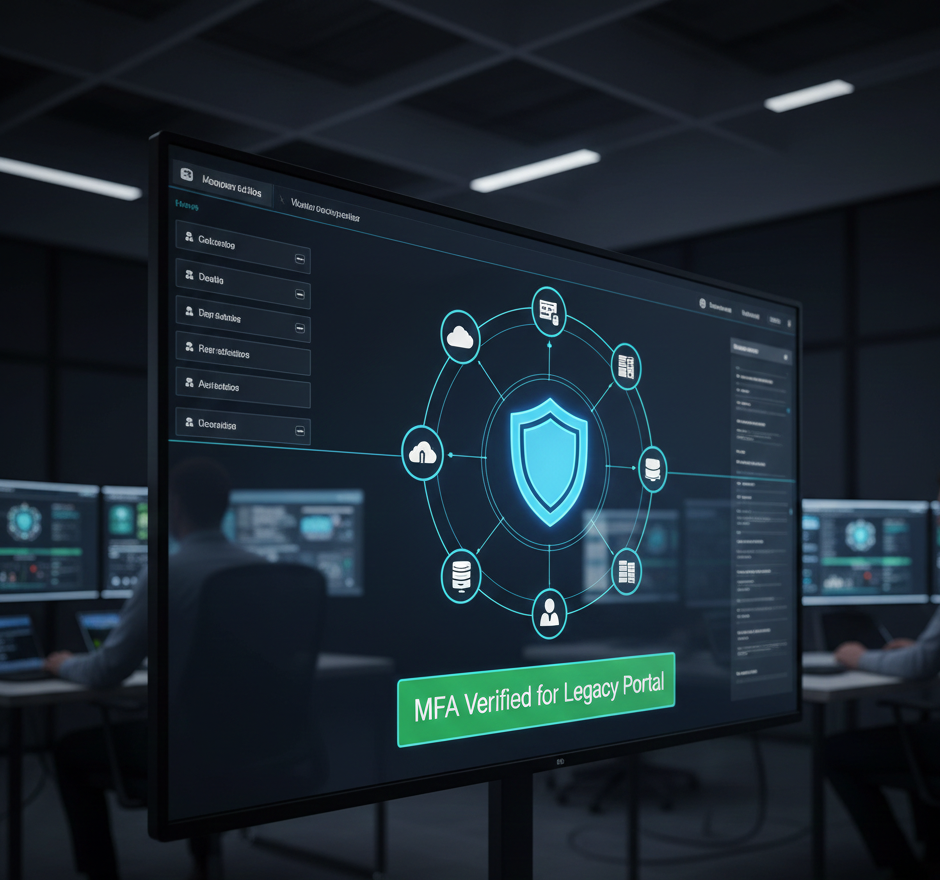
By bringing every legacy tool into the SSO fold, you gain a level of visibility and control that was previously impossible.
Unified Auditing: Every login to every app is recorded in one place. If a legacy system is accessed at three in the morning from an unusual location, your central security team will see the alert.
Instant Offboarding: When a staff member leaves, you only need to disable their one central account. Access to every connected legacy app is revoked instantly, closing a common loophole for data theft.
Reduced Support Burden: Users no longer need to call the helpdesk to reset forgotten passwords for obscure old systems. One password for everything means fewer tickets and more productive staff.
Key Takeaways: No Application Left Behind
Integrating legacy applications into a modern SSO ecosystem is no longer an optional luxury; it is a fundamental requirement for institutional security in 2026. As we have explored, the gap between old and new protocols can be bridged using identity gateways, reverse proxies, and secure vaulting. These solutions allow you to enforce strict multi factor authentication and zero trust policies across your entire digital estate, regardless of when an application was first built.
By taking these steps, you achieve three critical outcomes:
- A Hardened Security Posture: You eliminate the weak spots where attackers often gain a foothold, such as unsupported LDAP links or local password databases.
- Operational Excellence: You reduce the burden on your IT helpdesk by providing users with a single, reliable way to access every tool they need for their work.
- Future Proof Infrastructure: You prepare your institution for further cloud migration and the adoption of advanced identity features like passwordless login and biometric verification.
Overt Software Solutions specialises in these complex integrations. Our team has extensive experience in deploying Shibboleth and Azure AD/Entra ID environments that seamlessly incorporate legacy systems. We understand that every institution has a unique mix of old and new technology, and we provide the tailored expertise to ensure your transition is smooth, secure, and successful. Whether you are looking to secure a single legacy tool or overhaul your entire identity strategy, Overt is your partner in building a resilient digital future. Reach out to our technical experts today to start your integration journey.