
In the world of UK Higher Education and Public Sector IT, "Uptime" has long been the gold standard. If the server is pinging, we assume the service is working. However, as we move through 2026, this metric is increasingly misleading. An Identity Provider (IdP) can be "up," but if it is failing to release the correct attributes to a library database, or if latency is causing MFA timeouts, the service is—for all intents and purposes—down for the student.
To meet the rigorous standards of Cyber Essentials v3.3 (Danzell) and ensure a seamless user experience, we must shift our focus to Operational Monitoring that Matters.
The Uptime Myth: Why 99.9% Is Not Enough
In 2026, the most dangerous outages are "Silent Failures." These occur when the core infrastructure is running, but the handshake between the IdP and a Service Provider (SP) fails.
- The Scenario: Your Shibboleth IdP is healthy. Your Moodle VLE is healthy. However, a misconfigured attribute filter means students are being denied access because their "Enrollment Status" isn't being passed correctly.
- The Result: Your basic monitoring shows all "Green," but your helpdesk is being flooded with calls.
Proactive Identity Monitoring involves tracking the entire journey. We don't just ask "Is the server on?" We ask "Can a student successfully log in and access their specific resources in under two seconds?"
Key Metrics Every UK IT Director Needs
To gain a true picture of your identity health, your dashboard should prioritise these four areas:
- Authentication Velocity & Failure Spikes: A sudden increase in failed logins is the #1 indicator of a Credential Stuffing attack. In 2026, monitoring these spikes in real-time is a mandatory requirement for proactive threat detection.
- Attribute Release Accuracy: Are you sending too much data (a GDPR risk) or too little (an access failure)? Regular audits of attribute release logs ensure you are following the "Principle of Least Privilege."
- End-to-End Latency: If the journey from clicking "Login" to seeing the VLE dashboard takes more than 3 seconds, student engagement drops. Monitoring latency helps identify bottlenecks in your MFA provider or database lookups.
- SP-Specific Success Rates: If 100% of logins to Office 365 are working, but only 40% to a specific Library resource are successful, you have identified a targeted SP issue before the librarian even notices.
The Power of the Overt IdP Dashboard
For many UK IT departments, the Shibboleth Identity Provider (IdP) is a "black box." It generates thousands of lines of complex XML and text logs every hour, but extracting meaningful insights from them traditionally requires specialised scripting skills and hours of manual labour. In 2026, where IT teams are stretched thin, this manual approach is no longer sustainable.
The Overt IdP Dashboard acts as the "translator" for your identity infrastructure. It sits atop your managed IdP, ingesting raw authentication logs and converting them into a high-fidelity, real-time visual interface. This transition from "log files" to "business intelligence" offers several critical advantages:
- Visualising the Invisible: Instead of searching through text for a failed login, IT managers can see real-time heatmaps of authentication attempts. A sudden "red" spike on the map from a geographic region where you have no students is an immediate, visual indicator of a brute-force attack.
- Granular GDPR Compliance: Under UK GDPR, you must be able to prove exactly what Personal Identifiable Information (PII) is being sent to third-party Service Providers. The Overt Dashboard allows you to run "Attribute Release Reports" with a single click. You can see, for example, precisely which student data is being shared with an e-resource provider like Elsevier or Jisc, ensuring you are never over-sharing data.
- Proving ROI on Digital Subscriptions: University libraries spend millions on database subscriptions. The Overt Dashboard provides "Resource Usage Reports," showing which journals are being accessed most frequently and, crucially, which ones are ignored. This allows librarians to make data-driven decisions during contract renewals, often saving the institution tens of thousands of pounds.
- Seamless "Subject Access Requests" (SARs): If a student requests a copy of all data held on them, the Dashboard allows you to type in a username and export a full authentication history to CSV instantly. What used to take a technician half a day now takes thirty seconds.
Information Gain – The "Ghost Student" Detection (2026 Insight)
As we move through 2026, the threat landscape has shifted. One of the most significant challenges facing UK Higher Education is "Ghost Student" Fraud. This involves organised criminal groups using AI to generate synthetic identities that appear as legitimate student applications. Once enrolled, these "ghosts" use their university credentials to access high-value library resources for data scraping or to trigger fraudulent financial aid disbursements.
How Operational Monitoring Stops the "Ghost":Traditional security often fails here because the "student" has a valid username and password. However, proactive monitoring through the Overt IdP Dashboard identifies the behavioural anomalies that "ghosts" cannot hide:
- Velocity and Batching Alerts: AI-driven fraud rings often authenticate in "batches." Monitoring allows you to see if 50 "new students" all logged in for the first time within the same three-second window—a clear sign of a scripted bot rather than a human.
- Dormant Account Resurgence: "Ghost" accounts often sit quiet for weeks before suddenly attempting to download massive amounts of library data. Detailed monitoring flags this "Zero-to-Sixty" activity, allowing IT to lock the account for manual verification before the data is lost.
- Impossible Travel & VPN Fingerprinting: If a student’s record says they are based in a UK campus, but their authentication logs show a high-frequency of logins from a known commercial VPN exit node in another country, the dashboard's risk-scoring triggers an alert.
By integrating your Identity Monitoring with your Student Information System (SIS) through the Overt architecture, you create a "closed-loop" system. The moment a student’s engagement drops below a certain threshold in the VLE (a sign of a ghost identity), their library and research access can be automatically restricted until they perform a "Liveness Check" or biometric verification.
Automated Alerting and Condition-Based Maintenance
In 2026, the sheer volume of identity interactions makes manual oversight impossible. IT teams can no longer wait for a student to report a login issue; by then, the frustration has already set in, and the "user experience" has been compromised. The modern standard is Condition-Based Maintenance—observing the "health" of the system in real-time and acting before a defect escalates into a failure.
The "Service Provider Certificate" TrapOne of the leading causes of unscheduled downtime in Higher Education is the expiration of SAML certificates between the IdP and various Service Providers (SPs). With certificate lifespans shortening significantly in 2026 (often down to 47 or 90 days), the management burden has increased fivefold.
How Overt Automates the Solution:
- Multi-Stage Expiration Alerts: The Overt Dashboard doesn't just send a single "Expired" notification. It utilizes a sophisticated alerting chain—sending warnings at 30, 14, and 7 days. This allows your team to schedule a 5-minute update during a low-traffic window, rather than performing an emergency fix at 9:00 AM on a Monday.
- Service-Level Response (SLR) Tracking: Our monitoring doesn't just track if an SP is "up"; it tracks how it is performing against your agreed service levels. If a premium research database is consistently slow, you have the hard data needed to hold the vendor accountable.
- Automated Log Rotation and Health Scanning: The system continuously scans for "silent errors"—such as misconfigured metadata or signature mismatches—that might not prevent a login today but will cause a failure the next time a system is rebooted.
Predictive Analytics and Strategic Decision-Making
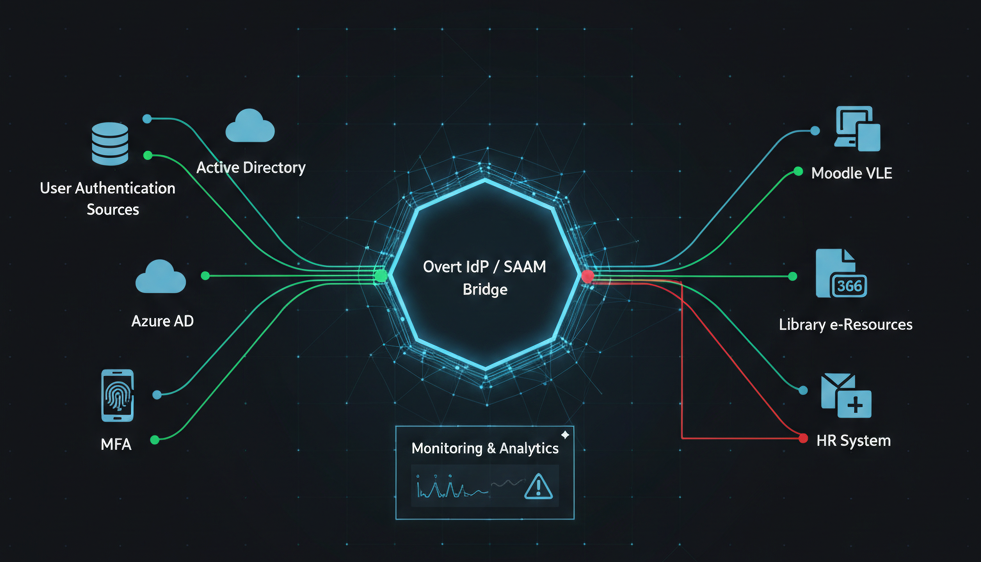
Beyond daily maintenance, Operational Monitoring provides the strategic insights needed for long-term planning. By analysing historical authentication trends, IT Directors can move from guessing their infrastructure needs to knowing them.
- Capacity Planning for "Peak Load": Universities experience massive surges in traffic during enrollment and exam periods. Overt’s predictive analytics analyse your previous three years of data to forecast exactly when your IdP will hit its threshold. This allows you to scale your cloud resources ahead of time, ensuring 100% availability during the most critical weeks of the academic year.
- The "Sustainability Signal": In 2026, UK institutions are under increasing pressure to meet Net Zero targets. Monitoring allows you to identify "Ghost SPs"—services that are still being paid for and hosted but have seen zero logins in six months. Decommissioning these not only saves budget but reduces your institutional carbon footprint and your cyber-attack surface.
- Dependency Mapping: Modern identity is an ecosystem. A failure in your MFA provider can look like a failure in your IdP. Our dashboard provides "Visual Dependency Maps," showing exactly how a student moves from their local device, through the Overt Bridge, and into the final resource. When a break occurs, you see exactly where the link is severed in seconds.
From Firefighting to Future-Proofing
Operational monitoring is no longer about checking boxes for an audit; it is about ensuring the heartbeat of the modern university—its digital identity—never skips a beat. By partnering with Overt Software Solutions, you gain more than a dashboard; you gain a team of engineers who watch the "pulse" of your institution 24/7.
Stop reacting to outages and start predicting success
We turn your raw logs into a strategic roadmap, helping you prevent fraud, prove ROI, and deliver a frictionless experience that students and staff expect in 2026. Contact Overt Software today for more info of the Overt IdP Dashboard.