
Higher Education (HE) organisations stand at a critical intersection of valuable data and inherent vulnerability. The academic environment is a paradox: it champions open collaboration, widespread access for students, researchers, and global partners, yet it is simultaneously a custodian of highly sensitive assets.
These assets range from decades of Personally Identifiable Information (PII) for current and former students, staff, and faculty, to highly coveted, state-of-the-art Intellectual Property (IP) developed through government and commercial research grants. For cybercriminals, a university network is a treasure trove: an academic bazaar of valuable data, often protected by aging infrastructure and an extremely large, constantly changing attack surface.
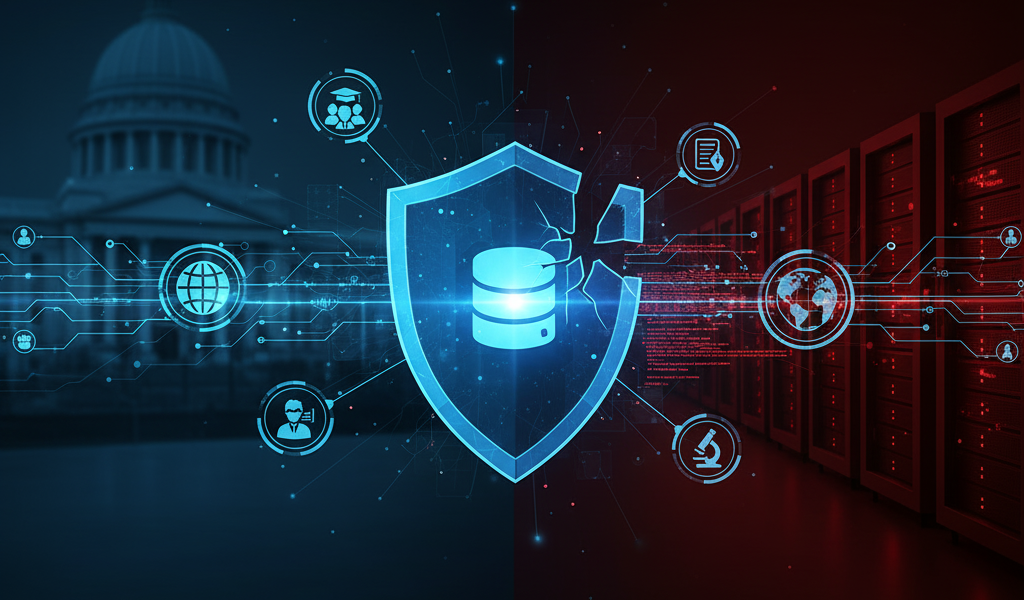
This complexity is why HE institutions continue to be disproportionately targeted by sophisticated attacks, including ransomware, espionage, and large-scale data theft.
As we begin 2026, it is vital to move beyond simply acknowledging the threat. We must study the failures of the past. The largest data breaches in the sector offer powerful, costly lessons in systemic weakness. The cases below do not just detail how data was lost; they highlight precisely where access control and identity governance failed.
We explore five defining incidents, focusing on their cause, impact, and the key strategic takeaways for securing your institution’s digital future.
Case Study 1: Massive PII Exposure via Centralised System: Maricopa County Community College District (2013)
This incident, affecting one of the largest community college systems in the US, is a classic example of the risk involved when decades of sensitive data are left exposed on legacy infrastructure.
The breach compromised the personal information of approximately 2.5 million current and former students, staff, and vendors, with some records dating back over 30 years.
The stolen data was highly sensitive:
- Names, addresses, and dates of birth.
- Social Security Numbers (the US equivalent of National Insurance Numbers).
- Financial aid information.
The aftermath was financially devastating, with costs rising to over £14 million (US$18 million) to cover credit monitoring, system remediation, and legal settlements.
The Cause: Ignoring Internal Warnings
The root cause was not a complex, unseen attack, but a persistent failure to address known, critical vulnerabilities on the main web server.
- Internal IT staff reportedly alerted management to security concerns years before the breach.
- The warnings were not actioned, leaving a persistent, exploitable flaw.
- The breach was only fully discovered when the FBI informed administrators that the stolen data was being sold online.
The Lesson: Access Governance and Zero Trust
Maricopa highlights the acute danger posed by legacy systems that hold vast amounts of PII. Security governance failed because internal warnings were ignored, and the existing perimeter was easily bypassed.
- Actionable Takeaway: Institutions must move beyond basic firewalls and adopt a Zero Trust framework. This would have limited the attacker’s ability to move laterally and exfiltrate data, even after the initial breach. Furthermore, security processes must ensure that the timely remediation of known vulnerabilities is a non-negotiable priority.
Case Study 2: The Supply Chain Vulnerability: Multiple Universities via MOVEit Transfer (2023)
This incident is not defined by a single institution, but by a widespread, simultaneous attack on numerous Higher Education (HE) organisations globally, including several major UK and US universities (such as John Hopkins University, University of Georgia, and others). This demonstrates how a flaw in one critical piece of shared software can instantly compromise an entire sector.
The scale was collective, affecting an unknown but massive number of individuals across dozens of institutions. The nature of the compromised data was broad, often including:
- Student and Donor PII: Names, addresses, contact details, and dates of birth.
- Medical and Health Information: Critical data held by university hospitals and medical research facilities.
- Financial Records: Sensitive accounting and payroll information transferred via the exploited application.
The impact was immediate and required frantic, coordinated incident response across multiple continents, placing immense strain on already stretched university IT teams.
The Cause: Exploitation of a Third-Party Software Flaw
The entire incident stemmed from a single, critical vulnerability—a zero-day exploit—in MOVEit Transfer, a managed file transfer software widely used by universities and large enterprises to securely send large files.
- The attackers, identified as the Clop Ransomware Group, leveraged the flaw to access data stored in the application's underlying database.
- Because the software was deployed identically across all victims, the attackers could automate the exploitation process, launching simultaneous attacks.
- This highlights the fundamental risk of relying on a single third-party product that acts as a central data hub.
The Lesson: Thorough Third-Party Risk Management
The MOVEit attacks proved that third-party software risks are no longer abstract; they are the primary source of widespread, high-impact breaches. Institutions may spend millions securing their internal network perimeter, only to be compromised via a vendor's unpatched flaw.
- Actionable Takeaway: Security teams must treat third-party vendor access and software with the same rigour as their own infrastructure. This means implementing and enforcing the principle of Least Privilege on third-party access accounts, performing regular, deep security audits of vendor products, and maintaining immediate patching protocols for all external-facing applications. Access governance must extend far beyond the university firewall.
Case Study 3: Ransomware and Operational Failure: University of Michigan (2023)
This incident serves as a stark reminder that modern ransomware attacks are designed to cause maximum disruption, aiming to cripple core academic and administrative services until a ransom is paid. The highly visible attack on the University of Michigan (UM) in 2023 caused unprecedented operational paralysis, making it a critical case study in resilience failure.
Unlike breaches focused purely on data theft, this attack forced the university to take most of its central IT systems offline immediately to contain the spread. The resulting shutdown lasted for days and significantly affected all facets of university life:
- Academic Disruption: Access to the Canvas Learning Management System (LMS), campus Wi-Fi, email, and virtual learning environments was halted, delaying classes and critical research.
- Administrative Freeze: Payroll, human resources, and financial systems were inaccessible, severely impacting daily operations.
- Data Compromise: While the full extent of exfiltration is often hard to confirm immediately, the incident was confirmed as a ransomware attack, meaning sensitive data was likely stolen before encryption.
The Cause: Unpatched Access Vulnerabilities
While the university was cautious about releasing technical details, large-scale ransomware attacks typically exploit two key vulnerabilities in HE environments:
- Weak or Unprotected Administrative Access: Attackers often gain entry using compromised credentials that lack Multi-Factor Authentication (MFA), enabling them to move laterally to high-privilege accounts.
- Vulnerable Remote Access: Gaps in virtual private network (VPN) or other external-facing access portals provide the initial foothold needed for the ransomware to be deployed.
The attack underscored a failure in the fundamentals of access control and network segmentation, allowing a small initial foothold to expand into a systemic failure.
The Lesson: MFA, Segmentation, and Guaranteed Resilience
The lesson here transcends data loss; it focuses on business continuity. A university cannot function without its digital infrastructure. Preventing such an incident requires mandatory security controls, while recovering from one demands specialist technical support.
- Actionable Takeaway 1 (Prevention): MFA must be non-negotiable for all staff and faculty accounts, especially those with administrative privileges. This immediately neutralises the efficacy of most compromised passwords used in ransomware entry.
- Actionable Takeaway 2 (Resilience): Organisations must have a specialised, 24/7 incident response plan backed by technical SLAs. Your critical systems, including your LMS and federated identity providers, require expert management to guarantee rapid recovery and minimal operational downtime. Resilience is an access management problem as much as a recovery one.
Case Study 4: Insider Threat via Neglected Access Governance: University of Hawaii (2005)
While this breach occurred years ago, it remains a classic, compelling study of the danger posed by the insider threat, particularly when access permissions are not rigorously reviewed or revoked. The failure here was one of governance, not perimeter defence.
The incident involved a former library employee who, after leaving the university, maintained access to the central campus database. The former staff member repeatedly logged in to the system, accessing records for hundreds of thousands of students.
The compromised data included:
- PII: Names, addresses, and contact details.
- Social Security Numbers for approximately 43,000 students and staff.
- Financial and educational records.
The breach severely damaged the university's reputation and led to immediate, costly system audits and mandatory security improvements across all campuses.
The Cause: Failure to Revoke Access
The cause was simple and preventable: the employee's credentials and permissions were never formally revoked upon their departure.
- The employee had legitimate administrative-level access during their tenure.
- Due to poor off-boarding procedures, this high-level access remained active after they left the payroll.
- The individual was able to log in remotely and browse or copy sensitive records over a period of weeks.
This incident is a prime example of a non-malicious but deeply costly administrative failure where the failure of identity lifecycle management led to a major data leak.
The Lesson: Lifecycle Management and Least Privilege
The crucial lesson here is that security is deeply intertwined with administrative processes. If a person no longer requires access for their role, their permissions must be eliminated immediately.
- Actionable Takeaway 1 (Lifecycle Management): Organisations must integrate their Identity and Access Management (IAM) systems with their Human Resources (HR) data. This ensures that when a staff member leaves or changes roles, their Single Sign-On (SSO) accounts and all associated privileges are automatically suspended or adjusted.
- Actionable Takeaway 2 (Least Privilege): No user, whether internal or external, should retain more access than is strictly necessary to perform their current duties. Access governance must be centralised to allow for fine-grained control and simple, timely revocation of permissions across all connected systems.
Case Study 5: Espionage and Intellectual Property (IP) Theft : UK and US Research Institutions (Ongoing, since 2018)
This final case study is not focused on a single institution, but on a sustained, coordinated effort by hostile foreign states and organised cybercrime groups to compromise the UK's leading research universities, including members of the Russell Group. The target is not PII for fraud, but national security assets and high-value research IP.
While the full financial loss is often classified, the theft of IP has the potential to cost the UK economy billions by undermining competitive advantages in key technological sectors like:
- Defence and AI Research: Sensitive dual-use technologies (civilian and military applications).
- Pharmaceutical and Biotech Development: Vaccine research and patented drug formulas.
- Engineering and Clean Energy Innovations: Prototypes and technical specifications.
The theft is often unseen until years later, when the stolen IP surfaces in a foreign competitor's commercial or military product, resulting in a silent but massive loss of economic value.
The Cause: Sophisticated Phishing and Weak Research Access
These attacks often bypass standard network defences by exploiting the open, collaborative culture of academia. The primary vectors are:
- Targeted Credential Theft (Spear Phishing): Highly specific emails (e.g., the "Silent Librarian" or "Stolen Pencil" campaigns) are used to trick specific researchers or administrators into giving up their login details.
- Third-Party Collaboration Gaps: Researchers often share access to sensitive data with overseas partners, sometimes without rigorous security checks, creating a loophole for foreign intelligence services.
- Weak MFA on Research Servers: Crucial research data repositories are often protected by basic passwords, allowing adversaries who possess stolen credentials to download massive amounts of data with ease.
The Lesson: Access Control for Data Classification
The key lesson from the government and intelligence briefings (including those from MI5 and the NCSC) is that universities are on the front lines of an economic and geopolitical conflict. Security measures must align with the value of the data being protected.
- Actionable Takeaway 1 (MFA and Vetting): MFA must be enforced universally, particularly for researchers working on sensitive projects. Access to high-value IP should be protected by the strongest available security measures, potentially including security vetting for key personnel.
- Actionable Takeaway 2 (Access Policy): Organisations must implement Attribute-Based Access Control (ABAC) or similar fine-grained policies. This ensures that only users with the correct attributes (e.g., current staff, British citizen, verified research partner, and physical location) can access specific, classified datasets. IP cannot be protected without treating research data as a high-security asset from creation to collaboration.
Common Threads in Academic Failure
The five case studies detailed above revealed three critical, repeating failure points in the Higher Education sector:
- Neglected Identity and Access Governance: Failure to enforce MFA, revoke old accounts, and align access with the principle of Least Privilege.
- Insufficient Operational Resilience: A lack of 24/7 specialist support and poor network segmentation, turning an intrusion into a total systems collapse.
- Third-Party and Legacy System Blind Spots: Allowing a single vulnerability in external software or an unpatched legacy system to expose millions of records or critical IP.
The time for simple perimeter defence is over. The only effective defence against these sophisticated, multi-vector threats is robust, centralised Identity and Access Management (IAM). By making the identity the new security perimeter, institutions can gain the fine-grained control needed to protect sensitive research, financial data, and student PII.
Securing 2026: An Investment in Resilience
As your organisation plans its security budget for 2026, the question is not if your institution will be targeted, but whether your access infrastructure is resilient enough to cope when the attack lands.
Investments must focus on foundational security elements: mandatory MFA, centralised Single Sign-On (SSO) for seamless governance, and the expert support needed to maintain these complex systems 24 hours a day.
Protect your institution from the lessons of the past. Talk to the experts at Overt Software Solutions today to assess your identity architecture and build a secure, resilient access management framework for the future of research and education.