In today’s digital workplace, employees rely on dozens of applications every day—from email and cloud storage to project management and learning systems. While this variety of tools makes work more flexible, it also creates a constant source of frustration: multiple logins, forgotten passwords, and wasted time. These challenges don’t just affect individuals; they slow down teams and increase costs for the organisation.
Single Sign-On (SSO) offers a practical solution. By allowing staff to use one secure login for all their applications, SSO removes barriers that hold back productivity. The result is smoother access, fewer helpdesk tickets, and stronger control over who uses which systems. Beyond convenience, SSO also lays the groundwork for better security and more effective access management—two essentials for any modern business.
In this blog, we’ll explore the top five single sign on benefits that show how SSO improves efficiency while strengthening the way organisations manage digital access. Along the way, we’ll also look at real-world examples of institutions that have transformed their operations by adopting SSO.
The Top 5 Ways SSO Improves Business and Efficiency
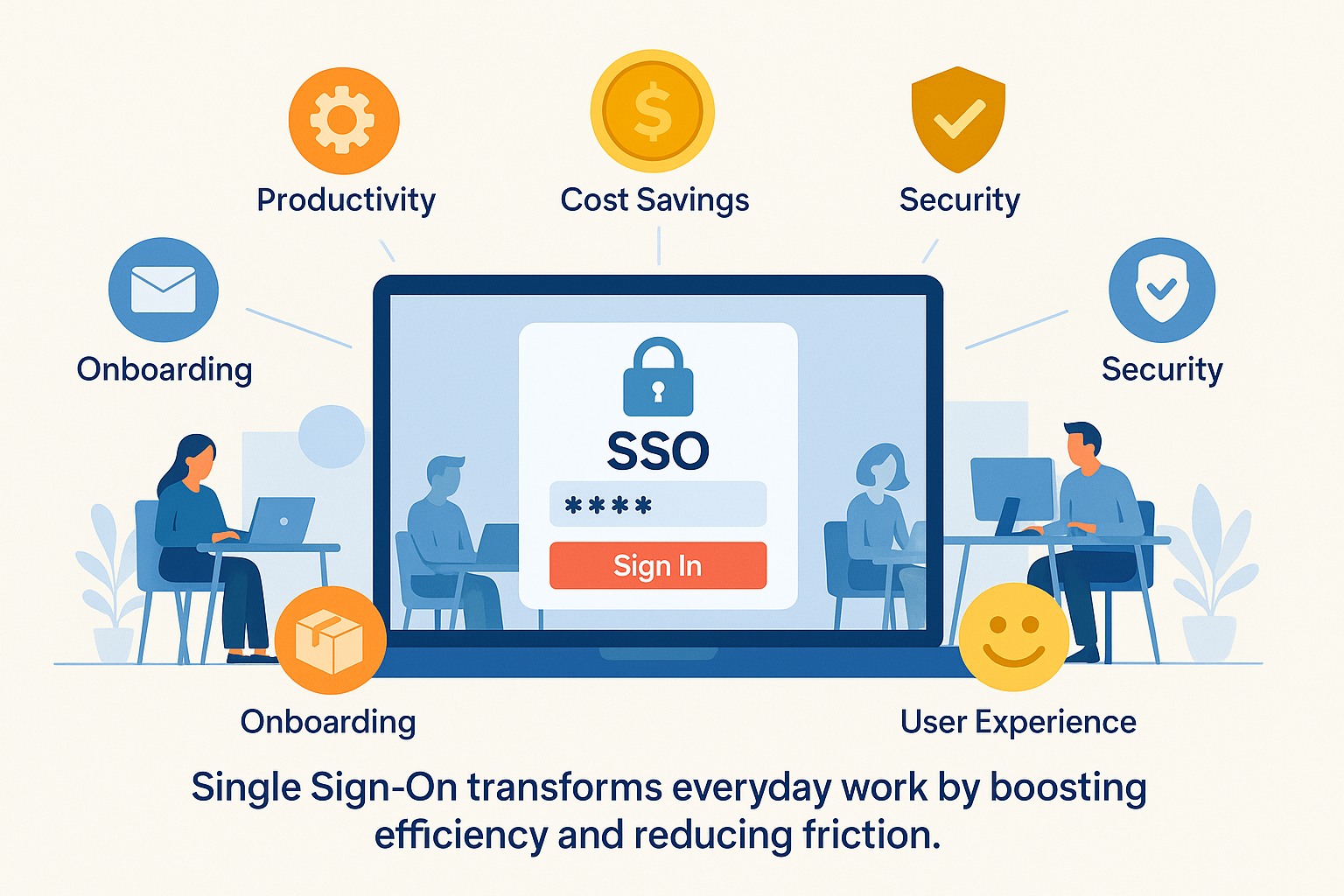
Implementing Single Sign-On does far more than save a few clicks at login. When organisations adopt SSO, the improvements ripple across productivity, IT support, and security. Here are five key benefits that show why SSO has become an essential tool for modern businesses.
- Reduced Password Fatigue - Employees no longer have to juggle dozens of different passwords for their daily applications. By using one secure login, staff can move between systems without interruption. The result is less frustration, fewer lockouts, and more time focused on actual work.
- Lower IT Support Costs - Password resets are one of the most common reasons users contact IT helpdesks. SSO dramatically reduces those calls. This frees IT teams from repetitive tasks and allows them to dedicate more energy to projects that support growth and innovation.
- Stronger Security Through Centralised Access - At first glance, one login may seem riskier, but SSO actually strengthens control. Access is managed in a single place, making it easier to enforce policies, revoke accounts when necessary, and integrate Multi-Factor Authentication (MFA). That centralisation closes many of the gaps that attackers typically exploit.
- Faster Onboarding and Offboarding - With SSO, new staff can access the tools they need on day one without lengthy setup. When someone leaves the organisation, administrators can disable access across all systems in just a few clicks. This speeds up transitions and reduces the risk of accounts being left open accidentally.
- Better User Experience Across Platforms - For teams working in hybrid or fully remote environments, easy access matters. SSO creates a smoother user journey by connecting cloud apps, internal systems, and learning platforms under one login. A better experience improves efficiency and contributes to overall job satisfaction.
Access Management and the Bigger Picture
Single Sign-On on its own already brings clear benefits, but its real power comes when it sits within a wider approach to access management. Businesses aren’t just looking for convenience; they also need a way to control who gets into which systems, how long they can stay there, and what they can do once inside.
Access management is the discipline that makes this possible. By centralising control, organisations can apply policies consistently across all applications instead of leaving each tool to manage its own login process. This means administrators can grant or revoke access quickly, monitor unusual activity more effectively, and ensure compliance with internal or regulatory requirements.
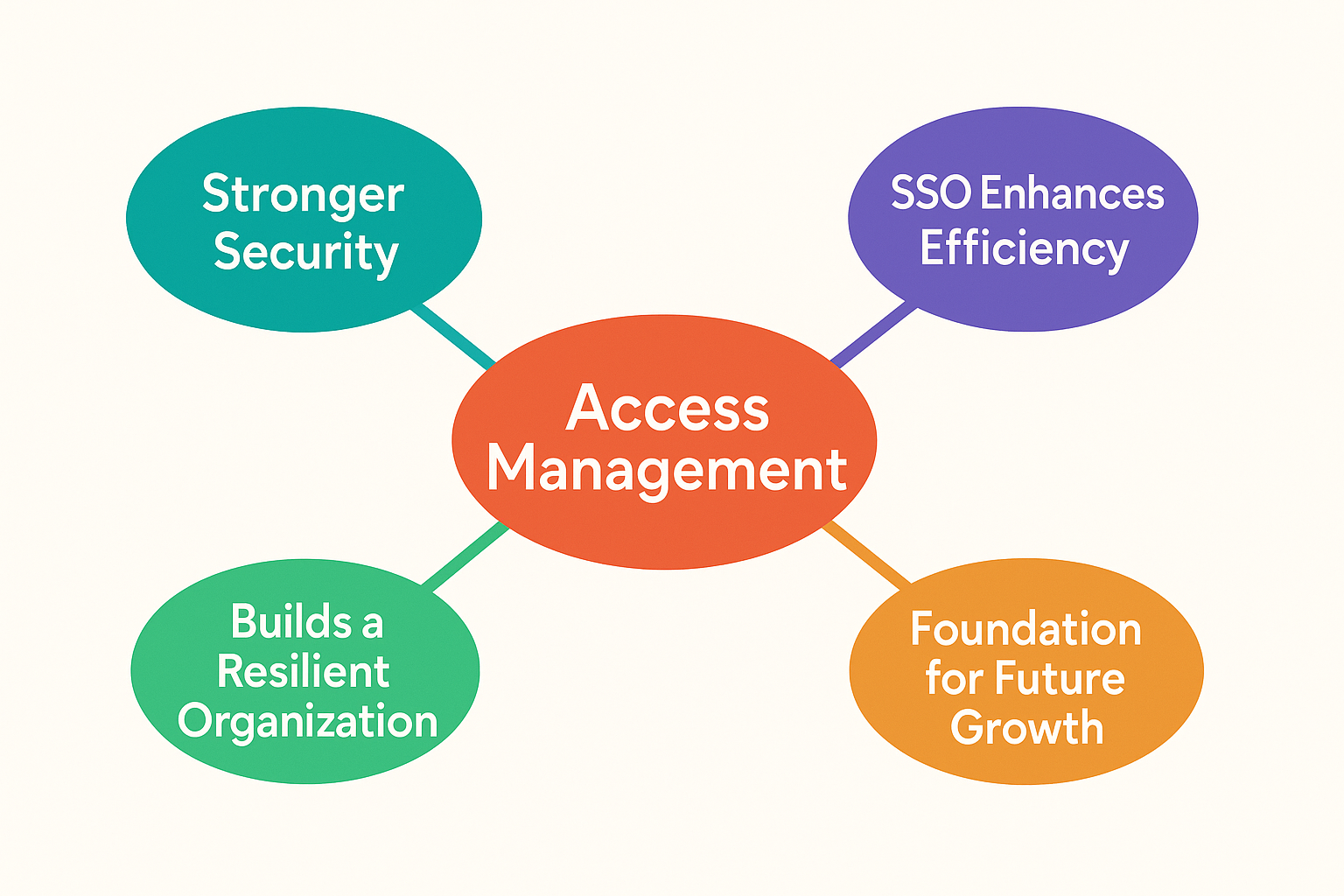
In practice, this creates a safer and more efficient environment. When staff move roles, their permissions can be updated in one place rather than across dozens of systems. If a contractor finishes a project, their account can be closed instantly. And by combining SSO with Multi-Factor Authentication, organisations reduce the risk of compromised credentials without slowing people down.
For Overt Software Solutions, this is where SSO connects with the bigger picture. Our focus on access management ensures that organisations don’t just get smoother logins, but also a foundation for stronger security and more agile operations. To illustrate how these benefits play out in practice, the next section shares real-world case studies that provide valuable lessons for anyone looking to strengthen efficiency and security through SSO.
Real-World Case Studies
Case Study 1: University of Hertfordshire – Ransomware Attack Disruption
In 2021, the University of Hertfordshire suffered a major ransomware attack that forced it to shut down its entire IT network. Students and staff suddenly lost access to critical systems including Office 365, LMS platforms, and remote learning tools. The timing couldn’t have been worse — classes had to be cancelled, deadlines were missed, and research projects were interrupted.
Investigations revealed that the attackers gained entry by exploiting weak points in authentication and outdated systems. Once inside, the ransomware spread quickly across connected services, encrypting files and cutting off users from essential resources.
The immediate impact was severe: a full outage lasting several days, frustrated students, damaged trust, and significant recovery costs. For a university with thousands relying on digital services daily, the attack highlighted just how vulnerable higher education can be.
Since the incident, Hertfordshire has strengthened its cybersecurity posture with stricter access management controls, regular patching, and a stronger emphasis on Multi-Factor Authentication. By moving towards more centralised login systems, including SSO, the university has been able to regain confidence and reduce the chance of widespread disruption from a single point of compromise.
Case Study 2: Moshi Co-operative University (MoCU), Tanzania — SSO Implementation for Better Access Management
Moshi Co-operative University (MoCU), a higher education institution in Tanzania, was facing challenges around managing access to multiple campus systems. Students and staff had to log into different portals and platforms separately—creating friction, password fatigue, and inefficiencies. Meanwhile, security and user convenience were becoming increasingly critical as more academic resources moved online.
How they approached change
MoCU decided to implement a Single Sign-On solution to streamline access across their various educational systems (e.g. learning platforms, portal, email, library services). They collected data via surveys, interviews, and system logs to understand user pain points and to design the rollout plan.
They encountered resistance: some users were hesitant to change their login habits, and technical integration with legacy systems was tricky. Also, aligning different systems (which used different authentication models) required careful mapping and testing.
What changed / impact
- Access to institutional systems became unified under one login.
- Users experienced fewer password problems and less frustration when switching between systems.
- Administrative overhead decreased: helpdesk calls about login issues dropped.
- Security improved because the access control point was more centralised and manageable.
What they are doing now to prevent future issues
- Ongoing training and communication to help users adapt to the new login system.
- Continuous monitoring of system logs to detect anomalous access patterns.
- Iterative improvements to system integrations and fallback mechanisms for legacy tools.
- Enforcing stricter access control policies for sensitive resources behind the SSO layer.
Case Study 3: Oracle Cloud – SSO / Authentication Breach Claim
In March 2025, a threat actor claimed to have breached Oracle Cloud’s authentication systems. They alleged that over 140,000 tenants were affected, with the attacker obtaining Java KeyStore files, encrypted SSO credentials, LDAP data, and enterprise identity metadata. The breach was centered on Oracle’s Single Sign-On (SSO) / authentication infrastructure.
How the breach occurred
According to the claims, the attacker exploited a vulnerability in the Oracle Access Manager component (CVE-2021-35587) in Oracle’s login endpoints (e.g. login.(region).oraclecloud.com). They allegedly exfiltrated encrypted SSO and LDAP credentials, as well as enterprise identity keys. The attacker also posted sample data and messaging on forums to draw attention to the breach.
What happened to them / impact
- Oracle publicly denied that any Oracle Cloud tenants were breached or experienced data loss.
- However, the claims sparked serious concern across affected organizations (customers) who rely on Oracle’s SSO / authentication services.
- The reputational risk was significant: even the allegation of a breach affecting authentication infrastructure (SSO, LDAP) causes loss of trust, scrutiny from clients, and pressure to audit and improve security.
What they are doing (or should do) to avoid recurrence
- Oracle would need to rotate and reissue credentials and cryptographic keys if they believe credentials were compromised.
- Enforce stricter Multi-Factor Authentication (MFA), shorten session lifetimes, and adopt token rotation policies.
- Conduct in-depth forensic audits on their authentication infrastructure, patch known vulnerabilities (especially CVE-2021-35587), and monitor logs closely for anomalous access patterns.
- Improve segmentation and least privilege around authentication systems, and adopt defense-in-depth (i.e., not relying solely on SSO).
Customer Success Stories with Overt
The benefits of Single Sign-On and access management aren’t just theoretical. Overt Software Solutions has worked with a wide range of institutions to simplify access, improve efficiency, and build stronger digital foundations. These stories highlight how organisations have tackled challenges and what others can learn from their experience.
Guildhall School of Music & Drama — Reliable Access Through Seamless Integration

Guildhall needed to bring its Moodle learning platform and Mahara ePortfolio together in a way that worked smoothly for both students and staff. Their previous hosting partner had left them dealing with plugin errors, downtime, and unreliable support. Overt migrated the systems, integrated Moodle and Mahara effectively, and reduced the administrative burden of maintaining them. The result was more reliable access, fewer login frustrations, and better continuity for learning and performance. The lesson is clear: when platforms are unified and well-supported, both security and efficiency improve.
University of Cumbria — Granular Access Control with Shibboleth
For the University of Cumbria, managing who could access different resources across departments had become complex and inefficient. With Overt’s support, the university introduced Shibboleth with granular access controls, allowing them to fine-tune permissions for staff and students. This not only improved security by reducing unnecessary access but also saved time for administrators, who could now adjust access centrally. It shows how access management and SSO principles go hand in hand, ensuring the right people reach the right tools without unnecessary barriers.
Royal Agricultural University — Scaling Access for International Reach
As the Royal Agricultural University expanded internationally, it needed a learning environment that would remain secure and accessible to students worldwide. Overt delivered a Virtual Learning Environment (VLE) designed to handle growth while protecting sensitive data. By combining scalability with strong access controls, RAU could reach new learners without compromising system reliability. This case illustrates how secure, centralised access empowers organisations to grow confidently.
Together, these stories show how Overt’s approach to access management and system integration supports smoother logins, stronger control, and greater efficiency. Each institution started from a different challenge, but the outcome was the same: more secure, reliable, and user-friendly systems.
Why Overt is the Right Partner
Managing access securely while keeping systems easy to use is a challenge for any organisation. The examples above show that when access management and Single Sign-On are handled well, the results are tangible: fewer login frustrations, lower support costs, stronger security, and systems that scale with growth.
Overt Software Solutions helps institutions achieve these outcomes by focusing on what matters most. Our expertise lies in:
- Single Sign-On and Multi-Factor Authentication (MFA) — making everyday logins faster while keeping accounts secure.
- Federated access management — centralising permissions so the right people have the right access at the right time.
- System integration and hosting — ensuring critical platforms like Moodle, Mahara, and VLEs run smoothly and reliably.
- Long-term support and guidance — helping staff and students adapt, stay informed, and make the most of secure access.
What sets Overt apart is our approach: we don’t just provide technology, we work alongside organisations to ensure solutions are practical, sustainable, and tailored to their needs. For education providers and businesses alike, that partnership creates a stronger digital foundation where innovation and efficiency can thrive.
The Key Takeaways
Efficiency and security no longer need to be competing priorities. With Single Sign-On, organisations can streamline access, reduce IT overhead, and give staff the freedom to focus on their work without compromising protection. The stories from both global institutions and Overt’s own customers prove the same point: when access management is done right, the result is stronger security and a more agile workplace.
For Overt Software Solutions, helping organisations get to that point is at the heart of what we do. By combining SSO, Multi-Factor Authentication, and federated access management with reliable long-term support, we make it possible for institutions to build systems that work better today and remain resilient tomorrow.
 If your organisation is ready to experience the real benefits of SSO, reach out to our team. Together, we can simplify your logins, strengthen your defences, and create an access experience that supports both productivity and growth.