Hybrid Identity and Access Management (IAM) is a strategic framework that synchronises and manages user identities across both local on-premises servers and cloud-based environments. By creating a unified "Identity Bridge," organisations ensure that a single set of credentials allows secure access to legacy hardware and modern SaaS applications. In 2026, this approach is essential for maintaining a Zero Trust security posture while complying with UK data residency and Cyber Essentials requirements.
Introduction: The Identity Bridge in a Decentralised World
In 2026, the boundary between "the office" and "the cloud" has effectively disappeared. For most United Kingdom enterprises, the dream of a total transition to the cloud has been replaced by a more practical reality: the Hybrid Estate. While cloud-native tools offer agility, many core functions—ranging from industrial control systems to sensitive financial databases—remain anchored on-premises due to legacy requirements or strict digital sovereignty laws.
The challenge for IT leaders is no longer just about moving data; it is about bridging the identity gap. If an organisation maintains separate silos for cloud logins and on-premises permissions, it creates "Identity Sprawl." This fragmentation is the primary cause of security breaches, as it allows orphaned accounts and inconsistent policies to go unnoticed.
The Regulatory Push in the UK
The urgency to unify these systems is further driven by the Cyber Essentials 2026 (v3.3) update from the National Cyber Security Centre (NCSC). As of April 2026, multi-factor authentication (MFA) is mandatory for every cloud service used by an organisation. Attempting to manage these mandates across two disconnected systems is not only inefficient but will also lead to an automatic failure during security audits.
By centralising identity, businesses can enforce a "Single Source of Truth." This ensures that when an employee leaves a company, their access is revoked across every platform—cloud or local—in a single action. This guide will explore how your organisation can build this bridge to ensure security, compliance, and a seamless user experience.
Why On-Premises Systems Remain Essential in 2026
Despite the rapid expansion of cloud services, on-premises infrastructure remains a cornerstone of the British IT landscape. As we move through 2026, the industry is witnessing a notable trend: Cloud Repatriation. Recent data indicates that approximately 87% of United Kingdom businesses plan to move at least a portion of their workloads back to local or private environments over the next two years.
There are three primary drivers for this shift:
1. Data Sovereignty and the 2025 Data Act
Compliance is no longer a "check-box" exercise; it is a matter of national legal standing. The Data (Use and Access) Act 2025 has reinforced the need for strict control over where sensitive information resides. For sectors such as healthcare, defence, and legal services, storing personal data within the physical borders of the United Kingdom is often a mandatory requirement. On-premises systems provide the absolute certainty that data is not subject to foreign jurisdictions, such as the United States CLOUD Act, which can sometimes conflict with UK privacy standards.
2. Operational Technology (OT) and Ultra-Low Latency
In industries like smart manufacturing and high-frequency trading, every millisecond matters. Cloud round-trips can introduce latency that disrupts real-time industrial control systems. The National Cyber Security Centre (NCSC) issued new guidance in January 2026 regarding Secure Connectivity for Operational Technology. This framework emphasises that critical infrastructure must often remain local to ensure "predictable performance" and safety.
3. The Legacy Reality and "Innovation Drag"
Many UK enterprises still rely on legacy applications that are "brittle" and difficult to migrate. With Windows Server 2016 reaching its final end-of-support milestone in January 2027, 2026 has become the year of "Hybrid-by-Design." Rather than a risky "lift and shift" to the cloud, organisations are using the Strangler Fig pattern—keeping the core legacy logic on-premises while wrapping it in modern cloud-based APIs and identity layers.
Strategic Approaches to Bridging the Gap
Achieving a unified identity requires more than a simple connection between two servers. In 2026, the strategy must account for diverse environments, including multi-cloud ecosystems and the rise of non-human identities.
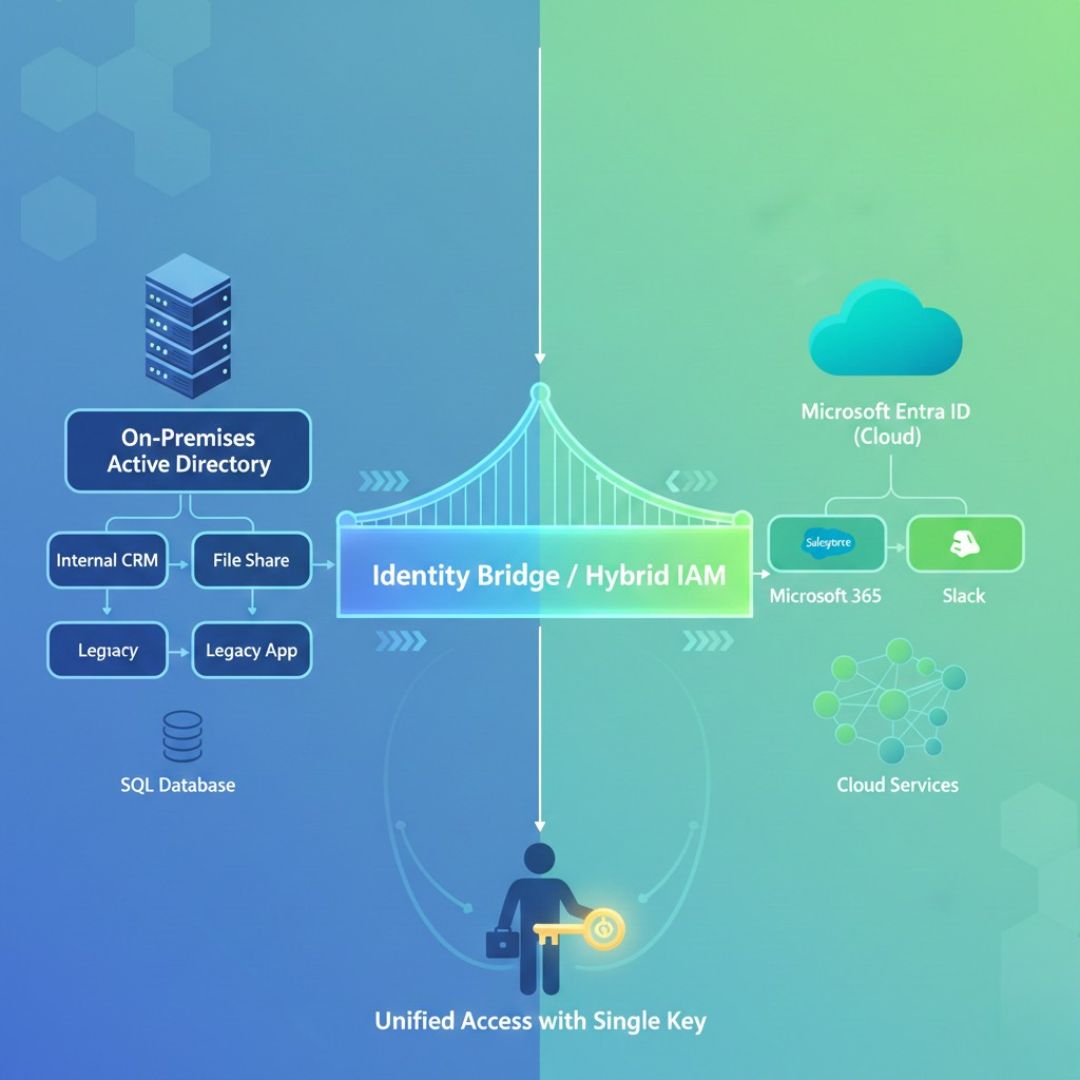
1. Architectures for Seamless Identity Integration
The foundation of a hybrid bridge lies in how you choose to synchronise your data. Organisations generally follow one of two paths based on their technical debt and security requirements.
Directory Synchronisation and Federation
For many UK businesses, Microsoft Entra Connect (formerly Azure AD Connect) remains the standard tool for synchronising on-premises Active Directory with the cloud. However, as of March 2026, Microsoft has enforced new security hardening measures to prevent "SyncJacking" or hard-match abuse. This update validates the OnPremisesObjectIdentifier to ensure that attackers cannot maliciously remap cloud accounts to on-premises identities.
For organisations seeking a lighter footprint, Entra Cloud Sync is now the preferred choice for multi-forest environments. It shifts the "heavy lifting" of the sync engine to the cloud, reducing the maintenance burden on local hardware.
Identity Orchestration: The 2026 Multi-Cloud Solution
As enterprises adopt multiple cloud providers (such as AWS and Google Cloud) alongside their on-premises estate, a single sync tool is often insufficient. Identity Orchestration has emerged as the "Identity Fabric" that sits above individual providers.
Rather than rewriting legacy applications to support modern protocols, orchestration layers use "Maverics" or "Identity Sidecars" to intercept traffic and provide the necessary credentials. This allows a business to maintain a consistent security policy across disparate systems without the need for extensive manual coding.
2. Moving to "Identity-First" Security
The traditional "castle and moat" security model is now considered obsolete by the National Cyber Security Centre (NCSC). In its place, the industry has adopted an Identity-First approach. In this model, the identity of the user (or the machine) is the primary perimeter.
- Context-Aware Access: Permissions are no longer static. In 2026, access is granted based on real-time signals such as the physical location of the user within the UK, the health of the device, and even typing patterns or biometric telemetry.
- Non-Human Identities (NHIs): With AI agents now performing autonomous tasks, your hybrid bridge must govern machine identities with the same rigour as human users. This involves implementing "Kill Switches" and automatic credential rotation for all API keys and service accounts that span the hybrid gap.
3. Establishing a Zero Trust Perimeter
The NCSC's updated Zero Trust Architecture principles (reviewed January 2026) recommend a "Mixed Estate" model. This acknowledges that while you may not be able to apply Zero Trust to every legacy on-premises tool, you can protect the entry point. By using a Cloud-Based Reverse Proxy, you can ensure that every request to a local server is authenticated and authorised in the cloud before it even reaches your internal network.
Implementation Best Practices: A Step-by-Step Roadmap with Overt Software Solutions
Transitioning to a unified hybrid identity model requires a structured approach to ensure that security and user experience remain balanced. Overt Software Solutions specialises in guiding organisations through this complex journey, particularly when integrating diverse environments such as Shibboleth and Microsoft Entra ID.
Below is the recommended roadmap for 2026, incorporating the unique tools and expert support provided by Overt Software Solutions.
Step 1: Conduct a Comprehensive Identity Audit
Before you can bridge your environments, you must understand what you are currently managing. Many United Kingdom organisations suffer from "Identity Debt"—legacy accounts and permissions that are no longer necessary.
The Overt Approach: Overt Software provides expert consultancy to audit your existing on-premises directories and cloud applications. This ensures that only active, verified identities are migrated or synchronised, reducing your attack surface from the outset.
Step 2: Unify the Login Experience with the SAAM Bridge
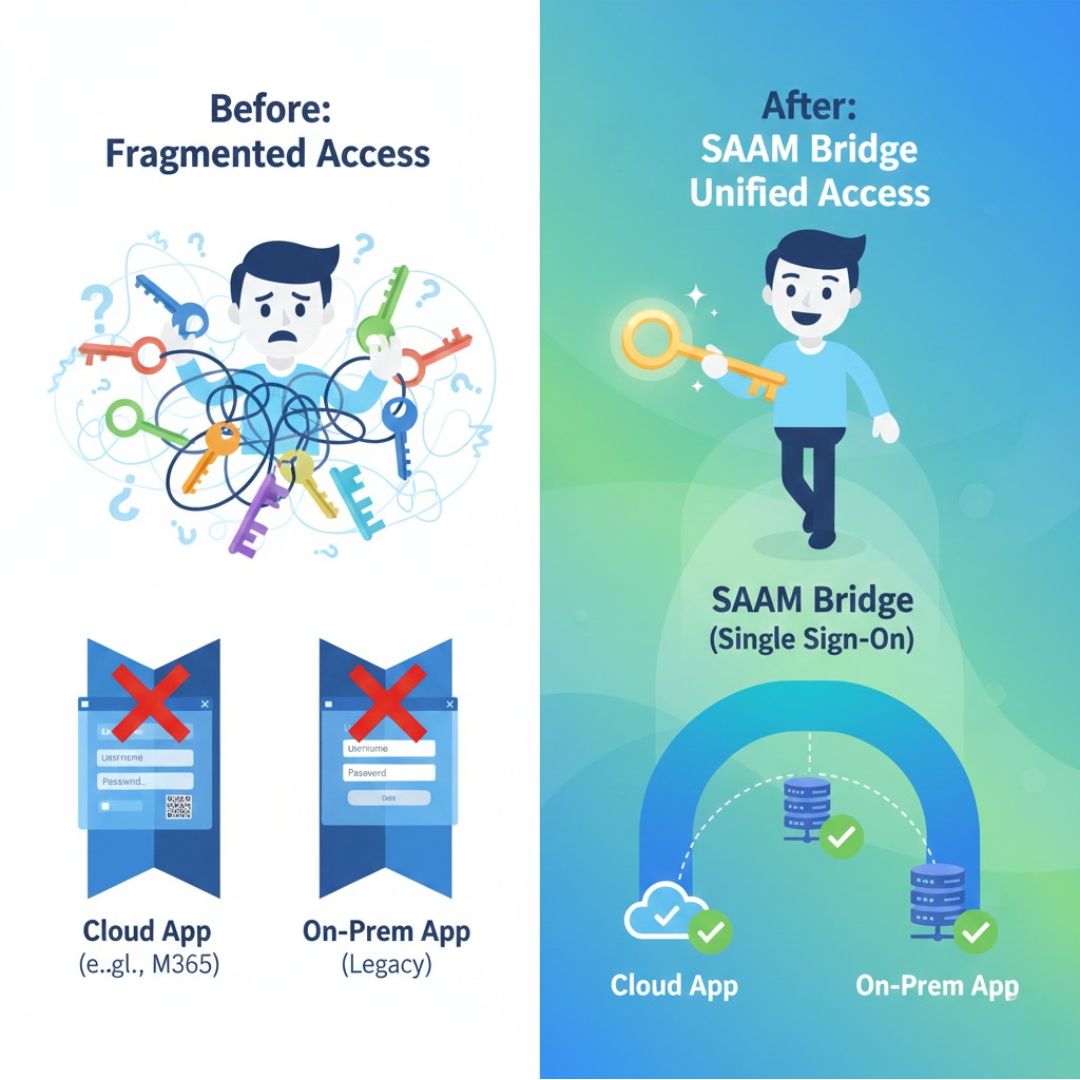
One of the most significant challenges in hybrid IAM is "login fatigue," where users must enter different credentials for different resources.
The Overt Solution: The SAAM Bridge (Shibboleth Azure AD / ADFS Module) is a bespoke solution designed by Overt Software to create a seamless connection between your Shibboleth Identity Provider and Microsoft Entra ID. This allows your users to enjoy a single, unified login experience whether they are accessing Microsoft 365 or a federated academic resource. It eliminates the need for double sign-ins and reduces helpdesk calls related to password resets.
Step 3: Enforce Contextual Multi-Factor Authentication (MFA)
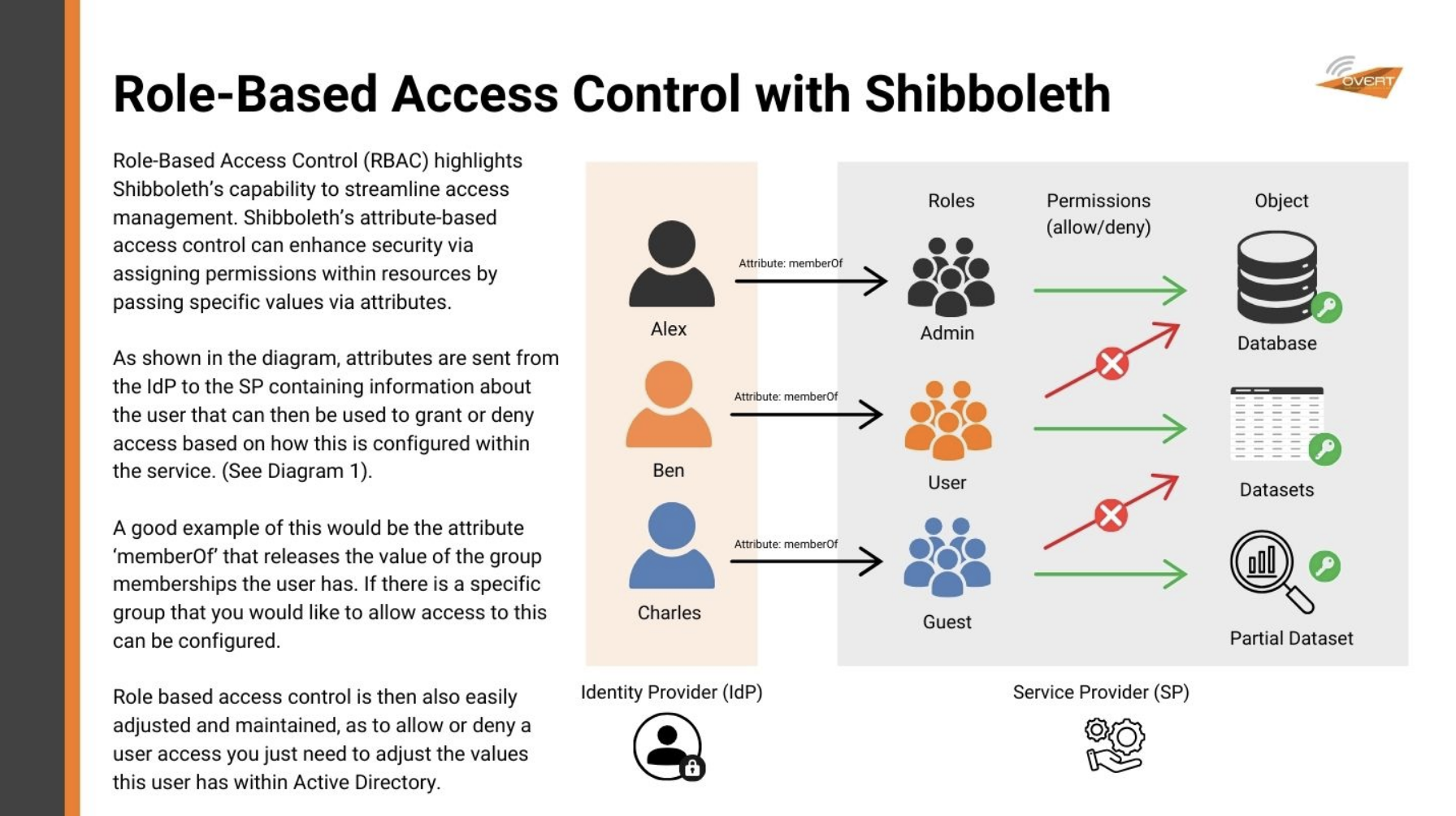
In 2026, a simple password is no longer sufficient. You must implement MFA that adapts to the risk level of the request.
The Overt Solution: Overt Software integrates advanced MFA and Self-Service Password Reset (SSPR) capabilities into your hybrid bridge. By using the SAAM Bridge, you can extend your Entra ID MFA policies to protect legacy on-premises applications that previously did not support modern security protocols. This ensures that every entry point into your network is protected by the same high standard of verification.
Step 4: Optimise Performance with Load-Balanced Hosting
A unified identity system becomes a single point of failure. If your Identity Provider (IdP) goes offline, your entire organisation loses access to its tools.
The Overt Solution: To prevent downtime, Overt Software offers IdP Load Balanced Pro hosting. These services are hosted in UK-based, ISO-27001 certified Tier 3 and 4 data centres. By spreading your identity infrastructure across multiple server clusters, Overt ensures "bulletproof" uptime and high availability, which is critical for 24/7 operations in sectors such as healthcare and higher education.
Step 5: Establish Continuous Monitoring and GDPR Compliance
Visibility is the final piece of the roadmap. You must be able to see who is accessing your data and ensure that personal identifiable information (PII) is handled correctly.
The Overt Solution: Every Overt IdP comes with a powerful, intuitive IdP Dashboard. This tool allows your IT team to generate granular reports on resource usage and authentication patterns. Crucially, it assists with UK GDPR compliance by providing clear visibility into what PII is being sent to external service providers, allowing you to fulfil data subject access requests with a single click.
For a deeper look at how to future-proof your identity infrastructure, explore the Overt Software guide to SSO and SAAM.
And youtube video reference:
Common Pitfalls to Avoid in Hybrid Identity Projects
Even with the best intentions, many UK organisations encounter significant hurdles when attempting to bridge cloud and on-premises environments. At Overt Software Solutions, we have identified several recurring failure points that can jeopardise both security and operational efficiency.
1. The "Fragility" of Self-Managed Sync Engines
Many IT teams attempt to manage their own synchronisation servers using default tools. However, without constant monitoring, these "identity bridges" can become a single point of failure. If the sync engine halts, new employees cannot log in, and leavers retain access to sensitive cloud data.
- The Overt Advantage: We provide fully managed Shibboleth and Entra ID environments. By shifting the burden of maintenance and monitoring to our dedicated support team, you ensure that your identity bridge remains resilient and up to date with the latest security patches.
2. Underestimating "Identity Sprawl"
Identity sprawl occurs when an organisation uses multiple disparate systems that do not communicate effectively. This leads to "Shadow Identity," where users create unmanaged accounts in SaaS applications to bypass restrictive local policies.
- The Overt Advantage: Our SAAM Bridge directly addresses this by unifying Shibboleth and Microsoft environments. It ensures that every application—whether local or cloud-based—is governed by the same central authority. This prevents the creation of "orphaned accounts" that are often targeted by cyber criminals.
3. Ignoring the "Zero Trust" Requirement for Legacy Apps
A common mistake is assuming that legacy on-premises applications are "safe" because they sit behind a firewall. In 2026, the Cyber Security and Resilience Bill requires that all critical infrastructure must be protected by robust access controls, regardless of its location.
- The Overt Advantage: We help you wrap your legacy applications in modern authentication layers. Through our consultancy, we ensure that even your oldest servers can benefit from Conditional Access Policies and FIDO2-compliant MFA, bringing them in line with modern UK security standards.
Key Takeaways & Future Outlook: The Era of Identity Orchestration
As we look toward the remainder of 2026 and beyond, the role of Identity and Access Management has shifted from a back-office utility to a frontline security mandate. The successful UK enterprise of the future will be the one that views identity not as a collection of passwords, but as a dynamic, intelligent Identity Fabric.
Bridging the gap between on-premises stability and cloud agility is no longer an optional upgrade; it is a fundamental requirement for digital sovereignty and resilience. Whether you are navigating the complexities of the Data (Use and Access) Act 2025 or preparing for the next wave of Agentic AI governance, your success depends on a unified, high-availability identity infrastructure.
Overt Software Solutions is committed to being your partner in this journey. By combining our deep technical expertise in Shibboleth and Microsoft ecosystems with our "True Single Sign-On" philosophy, we provide the tools and the hosting necessary to future-proof your organisation.
Ready to bridge the gap? Explore how the SAAM Bridge can transform your access management strategy today.