In the current academic year, the library is no longer just a physical building; it is a sprawling digital ecosystem of licensed data, research archives, and streaming media. As these resources have grown in value, so too has the sophistication of the threats against them. For UK Higher Education, the challenge is clear: how do we provide open, frictionless access for students while maintaining the rigorous security architecture required by Cyber Essentials v3.3 and UK GDPR?
The Librarian as a Security Stakeholder
Librarians are the guardians of the university’s most expensive digital assets. In 2026, a breach of library credentials does not just risk a data leak; it risks the termination of multi-million pound licensing agreements with publishers who demand "Identity-Based" proof of access. The role of the librarian has shifted from "Book Curator" to "Identity Governor," making their input vital in architectural decisions.
Moving Away from IP-Based Access
For decades, UK libraries relied upon IP-range authentication to grant access to scholarly journals. This "on-site" model assumed that if a user was physically present on campus, they were a legitimate student. However, in 2026, this architecture is fundamentally broken for three reasons:
- The Rise of Remote Learning: The modern campus is hybrid. Restricting the best research materials to a physical location creates a "digital divide" that disadvantages remote and international students.
- Browser Privacy Enhancements: Major browsers, including Chrome, Safari, and Firefox, have introduced "Hide My IP" features as default settings. By hiding the user's IP address to protect their privacy, these browsers inadvertently break traditional library access.
- The Proxy Vulnerability: Attackers frequently exploit poorly configured library proxies to "scrape" entire journals. Without individual identity verification, it is impossible to tell a genuine researcher from a malicious script.
The Zero-Trust Alternative
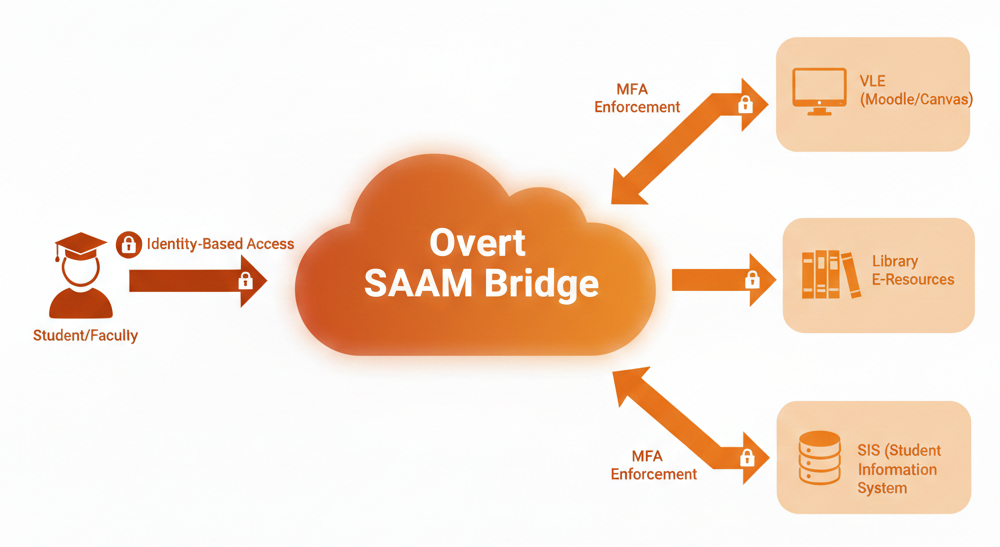
The secure alternative is a Federated Identity Architecture. By using Shibboleth or OpenAthens integrated with the Overt SAAM Bridge, the library can verify the individual identity of the user regardless of their location or browser settings. This ensures that access is granted based on who the user is, rather than where they are.
Information Gain: The "Ghost Student" Resource Drain
A unique insight for the 2026 academic year is the emergence of "Ghost Student" fraud. Organised cyber rings are now using generative AI to create synthetic identities and enrol in low-cost or "pay-later" courses at UK institutions. Their goal is not an education; it is the institutional credentials.
In the 2026 academic landscape, the "Ghost Student" phenomenon represents a sophisticated convergence of identity theft and institutional exploitation that moves far beyond simple academic dishonesty. This crisis is fueled by organized cyber rings that utilise generative AI to manufacture synthetic identities, blending stolen personal data with fabricated digital histories to bypass modern verification systems. These entities target UK institutions specifically through "pay-later" or low-entry-barrier courses, where the initial financial friction is low enough to allow for rapid, bulk enrollment. The core motive behind this infiltration is not the pursuit of knowledge but the acquisition of high-trust institutional credentials, such as official university email addresses and student identification numbers, which serve as a digital "golden ticket" for further criminal activity.
Once these synthetic students are embedded within a university’s system, the resulting resource drain manifests as a double-edged sword of financial loss and administrative paralysis. On one hand, these fraud rings siphon off maintenance loans and student grants, leaving the Student Loans Company and the universities to deal with the legal and financial fallout once the "ghost" disappears. On the other hand, the presence of these bots inflates enrollment numbers and consumes digital bandwidth, effectively displacing legitimate students from high-demand modules and forcing faculty to engage with non-existent learners. As UK universities navigate a precarious financial climate in 2026, the necessity of pivoting toward behavioral analytics and biometric "liveness" checks has become the primary defense against this AI-driven erosion of the educational infrastructure.
Why Library Resources?
High-value academic journals and research datasets are a valuable commodity on the dark web. Once a "Ghost Student" gains access to the university VLE, they use those credentials to scrape the library for proprietary research.
Architectural Countermeasure: Active Enrollment Verification
To combat this, Overt Software implements Active Enrollment Verification. Our architecture ensures that library access is not a "set and forget" permission. Instead, the system performs a real-time check against the Student Information System (SIS) every time a sensitive resource is accessed. If a student is flagged for non-attendance or suspicious activity, their library access is revoked immediately, even if their general login remains active.
Compliance and the "Danzell" Standard (Cyber Essentials 2026)

MFA for Every Resource
Under the Cyber Essentials v3.3 (Danzell) update, any cloud service—including third-party library databases—is in scope for assessment. If a journal provider supports Multi-Factor Authentication (MFA) and the university has not enabled it, the institution faces an automatic failure of its certification.
By unifying the library and VLE under a single Managed Identity Provider (IdP), Overt Software allows you to apply a single, robust MFA policy across every resource, satisfying the NCSC mandates without requiring students to manage multiple sets of security tokens.
Key Takeaways: Empowering the Modern Librarian
The transition to a secure identity architecture is an opportunity for UK librarians to reclaim control over their digital budgets and protect their students' privacy. By moving away from fragile IP-based models and embracing a Zero-Trust approach, libraries can become the most secure—and most accessible—hubs of knowledge on campus.
Overt Software Solutions specialises in this delicate balance. Our SAAM Bridge and Managed IdP services ensure that your library remains a fortress for data and a sanctuary for research.
Take the Next Step
Protect your e-resources for the 2026 academic year. Contact Overt Software Solutions for a Library Architecture Review.