Modern hybrid access management in 2026 is the strategic governance of user identities as they fluctuate between home, office, and third-party locations. For United Kingdom organisations, the standard has shifted from "Network-First" to "Identity-First" security. This approach employs Zero Trust principles, where access is granted based on real-time context—such as device health and biometric verification—rather than a physical location. By utilising solutions like the SAAM Bridge from Overt Software Solutions, businesses can unify cloud and on-premises logins into a single, secure, and frictionless experience that meets current NCSC guidelines.
Why the "Network Perimeter" Is Obsolete in 2026
For decades, the standard approach to remote security was to build a virtual wall around the corporate network. If a user was "inside" the wall—either physically in the office or connected via a tunnel—they were trusted. As we move through 2026, this model has fundamentally collapsed. The perimeter is no longer a physical boundary; it is the identity of the individual user.
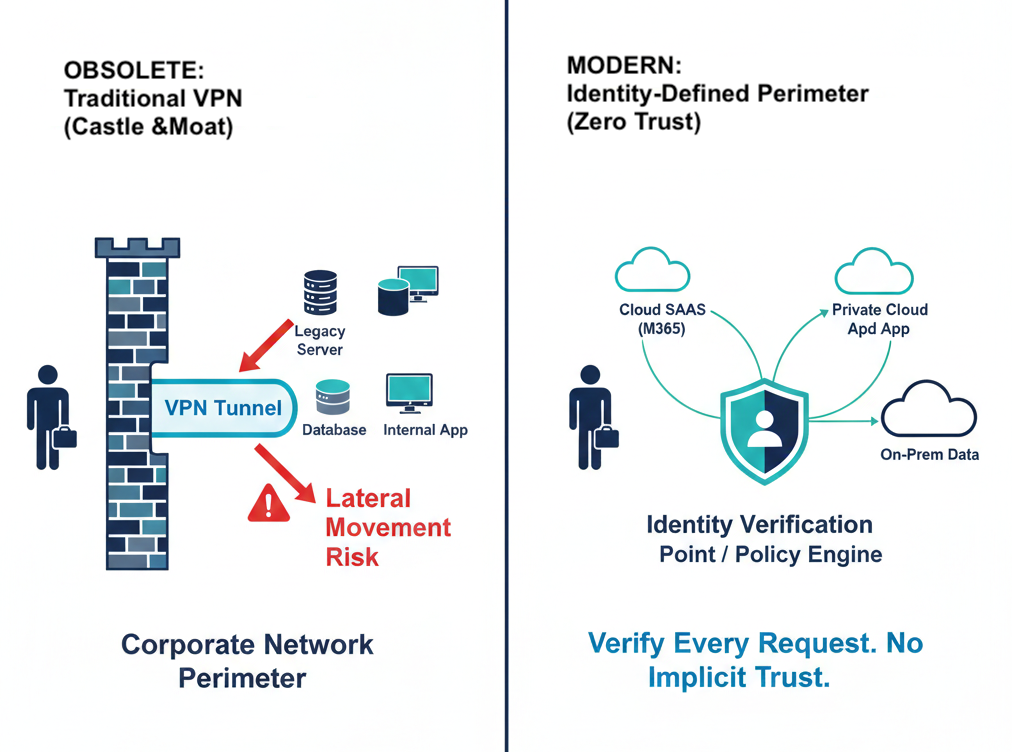
The Death of the VPN
The traditional Virtual Private Network (VPN) is increasingly viewed as a legacy tool that is not fit for purpose in a modern hybrid environment. While a VPN encrypts traffic, it often grants "ambient trust." Once a user is through the tunnel, they frequently have broad access to the internal network, which allows for lateral movement if an account is compromised.
Furthermore, as the UK government discusses potential age assurance and privacy restrictions on personal VPN use, corporate reliance on standalone VPNs has become a point of operational risk. Organisations are instead moving toward Identity-Defined Perimeters. In this model, every request to an application is individually authenticated and authorised based on the identity of the user and the security posture of their device.
The Impact of the 2026 Cyber Security and Resilience Bill
The legislative landscape in the United Kingdom has undergone a significant shift with the full implementation of the Cyber Security and Resilience Bill. This legislation mandates that all organisations managing essential or digital services—including data centres and managed service providers—must implement "appropriate and proportionate" security measures.
Under this bill, "best practice" has become a legal obligation. This includes:
- Mandatory Phishing-Resistant MFA: Traditional SMS-based codes are no longer sufficient for high-risk remote access.
- Rapid Incident Reporting: Organisations must now provide an initial notification of a significant incident within 24 hours.
- Supply Chain Scrutiny: Security teams are now legally responsible for the access methods used by third-party contractors and managed service providers.
Transitioning to Contextual Security
In a hybrid world, the location of the user (e.g., a London office versus a home in Edinburgh) is just one of many signals. A robust access management strategy in 2026 uses "Contextual Security" to make decisions. If a user attempts to access a sensitive financial database from an unmanaged device at 3:00 AM, the system should automatically step up authentication or block the request, regardless of whether they have the correct password.
Establishing a "Single Source of Truth" through centralised identity management is a critical component of this transition. This approach allows security teams to enforce consistent, context-aware policies across a distributed estate. By unifying identities, an organisation ensures that security measures are applied uniformly, regardless of whether a user is accessing a local server or a cloud-based application, thereby reducing the risk of policy gaps.
Industry Perspectives: Tailoring Access for Diverse Hybrid Environments
Access management is not a "one-size-fits-all" solution. In 2026, the specific operational requirements of an industry dictate how identity bridges are constructed. Whether it is managing thousands of student identities or protecting high-frequency financial data, the hybrid model must adapt to the unique risks of the sector.
Higher Education: Securing Global Researchers and Students
United Kingdom universities operate as mini-cities, often managing a highly transient population of students, staff, and international research partners.
- The Federated Identity Challenge: Higher Education relies heavily on federation. A researcher in Bristol may need to access a dataset hosted in Edinburgh using their local credentials. This requires a robust Shibboleth or OpenAthens implementation that can communicate seamlessly across institutions.
- The Rise of Mobile IDs: Physical ID cards are rapidly being replaced by mobile credentials that use biometrics and encryption. This transition allows universities to grant "just-in-time" access to labs and digital libraries, ensuring that remote students have the same level of security as those on campus.
Finance & Professional Services: High-Stakes Compliance
For the financial sector, 2026 marks the "prove it" phase of the FCA Operational Resilience framework. Regulators now require firms to demonstrate they can remain within "impact tolerances" during a cyber incident.
- Preventing Data Leakage: In a hybrid world, "Work from Anywhere" (WFA) introduces the risk of data being accessed on unmanaged home networks. Access management systems in finance now use Data Loss Prevention (DLP) integrations to block the downloading of sensitive files if the user is not connected via a verified, secure environment.
- Continuous Evaluation: Financial institutions have moved beyond a single login. They now use continuous evaluation to monitor session risk. If a user’s behaviour suddenly changes—for example, if they begin downloading an unusual volume of client records—the system can automatically terminate the session.
The Tech Sector: Securing "Agentic AI" as a Remote Identity
The technology sector is at the forefront of the next major identity shift: Agentic AI. These are semi-autonomous AI agents that perform tasks such as code deployment or system monitoring on behalf of human developers.
- Non-Human Identities (NHIs): In 2026, tech companies often have more non-human identities than human employees. Managing these "machine identities" is a critical security requirement. These agents must be assigned distinct identifiers, governed by strict "Least Privilege" policies, and monitored for signs of "model drift" or unauthorised activity.
- Developer Trust: As attackers increasingly target the tools that developers use, securing the access of the "builders" has become a top priority. This involves moving toward a model of Zero Standing Privileges (ZSP), where access to production environments is granted only for the duration of a specific task.
Information Gain: Beyond Static MFA to "Continuous Trust"
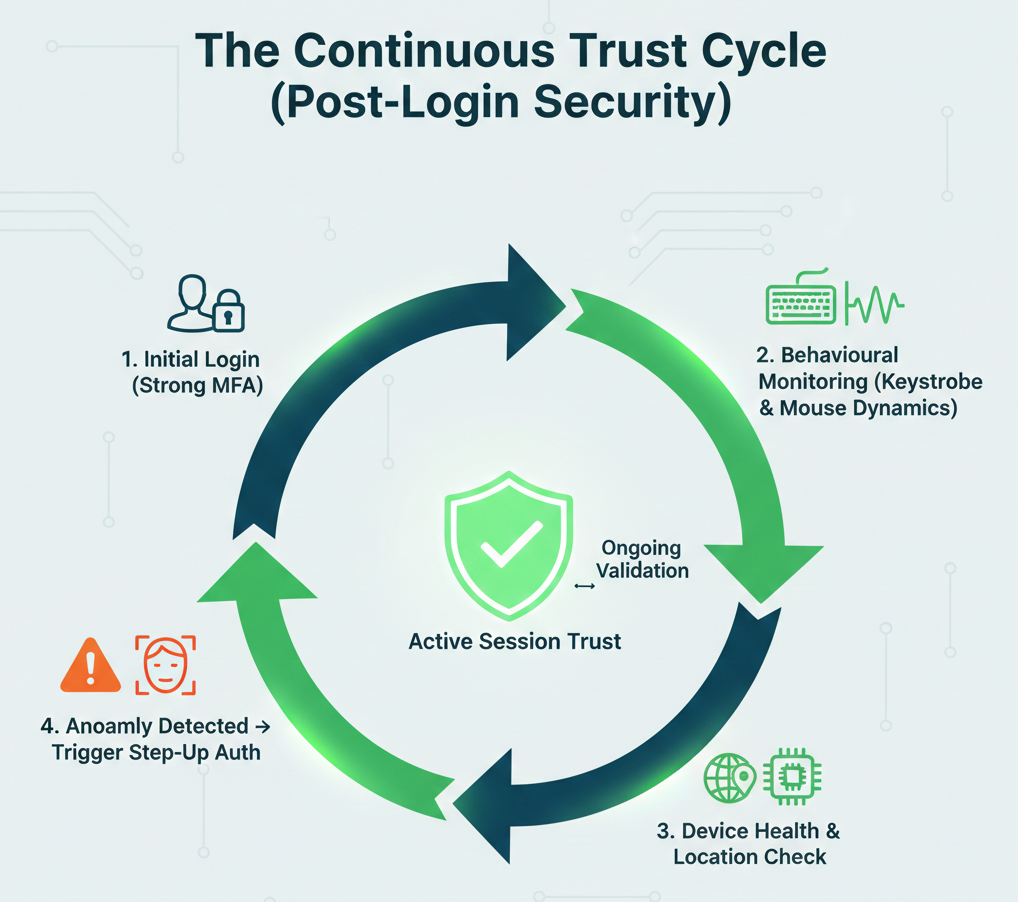
In the traditional remote work model, authentication was a single event: a user entered their credentials, completed a multi-factor authentication (MFA) challenge, and was granted access for the duration of a shift. In 2026, this "snapshot" approach is considered insufficient. The modern hybrid strategy has moved toward Continuous Trust, where the identity of a user is verified consistently throughout their entire session.
Continuous Authentication and Session Risk Monitoring
Continuous authentication uses passive signals to ensure that the person who initially logged in is the same person still using the device. If a user leaves their laptop unattended in a public space, or if a session is hijacked via a sophisticated token-theft attack, traditional MFA cannot detect the change.
By contrast, 2026 systems monitor Behavioural Biometrics, such as:
- Keystroke Dynamics: The unique rhythm and speed at which an individual types.
- Mouse Movement Patterns: Distinctive patterns in cursor velocity and acceleration.
- Device Telemetry: Constant checks on the health and location of the device.
If these signals deviate from the established "normal" profile, the system can automatically trigger a "step-up" authentication (such as a facial scan) or terminate the session. This level of granular control is a core requirement of the NCSC Zero Trust Architecture principles, which assume that any network is potentially hostile.
Agentic Identity Governance: The New Remote Worker
One of the most significant shifts in 2026 is the management of Agentic AI. Many organisations now use semi-autonomous AI agents to perform complex remote tasks—such as automated data analysis or cloud infrastructure management—on behalf of human employees.
These agents act with their own set of permissions, but they often lack the same level of oversight as human users. Information gain in this area involves implementing "Know Your Agent" (KYA) protocols. This includes:
- Unique Machine Identifiers: Every AI agent must be uniquely identifiable and linked to a human "owner."
- Short-Lived Credentials: Using just-in-time (JIT) access to ensure that an agent only has permissions for the exact duration of its task.
- Auditability: Ensuring that every action taken by an AI agent is logged with the same rigour as a human administrator.
The UK Digital Identity & Attributes Trust Framework (DIATF)
As of 2026, the Data (Use and Access) Act 2025 has fully legitimised the use of decentralised digital identities in the UK. Rather than every organisation storing a vast database of employee passports and driving licences—creating a significant liability under the UK GDPR—businesses are adopting the UK DIATF standard.
This allows employees to use a verified Digital Wallet (such as the GOV.UK Wallet) to prove their identity and "Right to Work" status. For a hybrid organisation, this reduces "Identity Debt" and simplifies the onboarding of remote staff, as the business only needs to verify a digital token rather than processing raw identity documents.
Unifying Your Hybrid Workforce with Overt Software Solutions
Building a resilient access management strategy requires the right architectural foundation. In 2026, the goal for any UK-based organisation is to provide a "True Single Sign-On" experience that secures the remote user without introducing unnecessary friction. Overt Software Solutions provides the specialised tools and managed services necessary to bridge the gap between complex on-premises directories and modern cloud environments.
Eliminating Friction with the SAAM Bridge
One of the most frequent complaints from hybrid workers is "login fatigue." When a user must authenticate separately for Microsoft 365 and then again for a federated research tool or a legacy on-premises application, security often suffers as users seek workarounds.
The SAAM Bridge (Shibboleth Azure AD / ADFS Module) is a bespoke solution that creates a seamless connection between the Shibboleth Identity Provider and Microsoft Entra ID. By translating authentication protocols into a unified flow, the SAAM Bridge allows a user to sign in once and move effortlessly between Microsoft resources and federated services. This ensures that the user experience is consistent, regardless of whether the employee is working from a corporate office in London or a remote location.
Reliability Through Managed, Load-Balanced IdP Hosting
In a hybrid world, the Identity Provider (IdP) is the "single point of success." If the IdP is unavailable, the entire organisation is effectively locked out of its digital tools. To mitigate this risk, Overt Software offers IdP Load Balanced Pro hosting.
These services are hosted in UK-based, ISO-27001 certified Tier 3 and 4 data centres, providing a level of physical and digital security that is difficult for individual organisations to maintain on-premises. With a standard 2-hour first response SLA, IT leaders can ensure that their remote workforce remains productive 24/7. The "Deploy Anywhere" ethos means these solutions can be integrated with your existing infrastructure, whether it resides on AWS, Azure, Google Cloud, or Overt’s private high-availability cloud.
Insights and Auditing with the IdP Dashboard
Visibility is the cornerstone of 2026 security compliance. To manage a hybrid workforce effectively, IT managers must be able to track access patterns and identify potential threats in real-time.
All Overt services include access to a powerful, intuitive IdP Dashboard. This tool provides:
- Granular Access Control: The ability to define exactly which groups of users can access specific resources without needing to modify complex XML configuration files.
- Real-Time Authentication Reports: Monitoring where and when users are authenticating to identify anomalies.
- GDPR Compliance Tools: Identifying what Personal Identifiable Information (PII) is being shared with third-party providers, which is essential for fulfilling Subject Access Requests (SARs) under the UK GDPR.
Summary Checklist: Is Your Access Management Ready for 2026?
To ensure your hybrid and remote access strategy meets the current standards of security and efficiency, verify that your organisation can answer "Yes" to the following:
- Is your MFA phishing-resistant? Does your system support modern standards like FIDO2 and WebAuthn?
- Do you have a "Single Source of Truth"? Are your cloud and on-premises identities unified under a single management layer?
- Is your identity infrastructure resilient? Do you have load-balanced hosting with a guaranteed response SLA?
- Can you audit access in real-time? Do you have visibility into which users are accessing which resources and from what locations?
- Is your user experience frictionless? Are your employees able to access all necessary tools with a single login?
Key Takeaways
As remote and hybrid work becomes the permanent operational model for many United Kingdom industries, the focus must remain on securing the identity rather than the network. By adopting a Zero Trust approach and utilising high-availability bridges like the SAAM Bridge, organisations can protect their data while empowering their workforce to collaborate securely from anywhere.
Ready to Secure Your Hybrid Workforce?
Navigating the complexities of 2026 security mandates does not have to be a solo journey. Whether you are looking to eliminate login fatigue with the SAAM Bridge or require high-availability hosting for your Identity Provider, the team at Overt Software Solutions is here to help.
Book a Free Identity Architecture Consultation to discuss your specific requirements.