
Beyond Manual Onboarding: Automating the User Lifecycle with ACIM and Just-In-Time Provisioning for UK Higher Education
To automate the user lifecycle effectively, organisations must combine Automated Cloud Identity Management (ACIM) with Just-In-Time (JIT) Provisioning. ACIM serves as the architectural backbone, synchronising identity data across platforms, while JIT provisioning dynamically creates user accounts the moment a person first authenticates via Single Sign-On (SSO). This dual approach eliminates manual administrative tickets, reduces the risk of "ghost accounts," and ensures that students and staff in the United Kingdom gain immediate, role-based access to Virtual Learning Environments (VLEs) without prior manual intervention from IT departments. This synergy optimises operational efficiency and strengthens security posture.
Understanding the Mechanism: How ACIM and JIT Interact
In a modern educational or corporate environment, the transition from a "new starter" to an active user can often be delayed by manual data entry. Just-In-Time provisioning solves the "day one" access problem. When a user logs in through a trusted Identity Provider (IdP)—such as Shibboleth or Azure AD—the system checks if an account exists. If it does not, the system creates the account instantly based on the attributes passed through the SAML or OIDC token.
However, JIT provisioning alone is often insufficient for the full lifecycle. This is where ACIM becomes essential. While JIT handles the creation, ACIM manages the ongoing maintenance and eventual deactivation of the account. For UK institutions, this ensures that when a student completes their course or a staff member leaves, their access is revoked across all connected systems simultaneously, maintaining strict compliance with UK GDPR and Cyber Essentials Plus requirements.
The Evolution of Identity Management in 2026
From Static Directories to Intelligent Operations
In previous years, identity management was often viewed as a static repository—a simple list of names and permissions stored within an on-premises directory. However, the 2026 landscape has shifted towards Intelligent Operations. Modern organisations no longer rely on periodic manual audits. Instead, they require dynamic systems that respond to real-time data signals.
For many UK institutions, the challenge lies in the fragmentation of data. When a student enrols via a Student Information System (SIS) or a staff member is added to a Human Resources (HR) platform, there is often a significant delay before those credentials propagate to the Virtual Learning Environment (VLE). By shifting to an automated model, IT departments move away from being "gatekeepers" and become facilitators of seamless access.
Why the UK Education Sector is Leading the Transition
The drive toward automation in the United Kingdom is not merely a matter of convenience; it is a response to the 2026 Compliance Imperative. With the tightening of Cyber Essentials Plus standards, manual account creation is increasingly viewed as a security liability. Manual processes are prone to human error, which can lead to over-privileged accounts or, more dangerously, "orphan accounts" that remain active long after a user has departed the institution. Automated Cloud Identity Management (ACIM) ensures that the digital identity remains synchronised with the official record of the institution at all times.
Understanding Just-In-Time (JIT) Provisioning
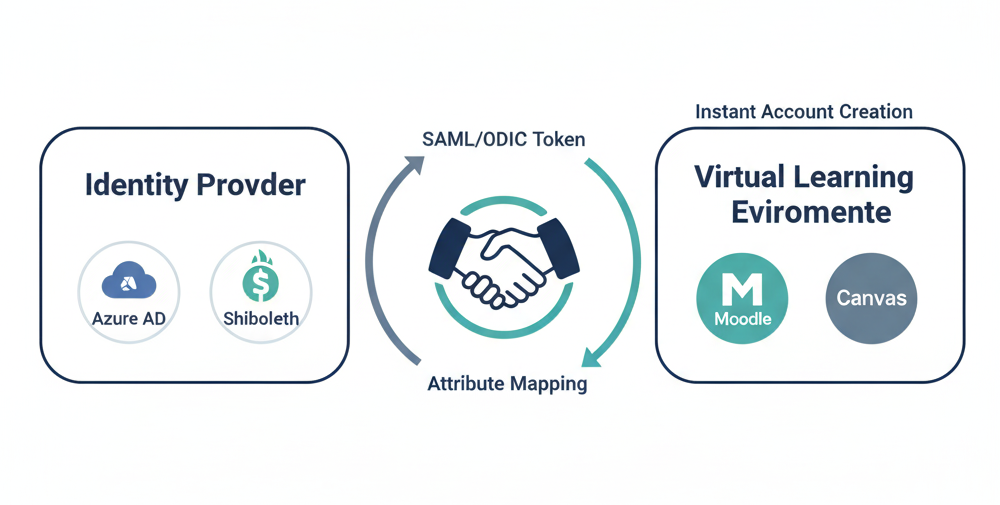
How JIT Works During the First Handshake
Just-In-Time provisioning operates on the principle of efficiency. It triggers the creation of a user profile at the exact moment of need—specifically, during the first successful authentication event.
When a user attempts to access a service such as Moodle, Canvas, or a library resource, the Identity Provider (IdP) sends a secure token—typically via SAML 2.0 or OpenID Connect (OIDC). This token contains "attributes" or "claims," such as the user’s name, email address, and institutional role. If the target application does not recognise the user, it uses these attributes to build the account instantly.
The Efficiency Gains: Instant Access, Zero Admin
The primary benefit of JIT is the total elimination of "pre-provisioning" tasks. IT staff do not need to bulk-upload CSV files or manually create thousands of accounts before the start of a new academic term. This "zero-touch" approach ensures that even if a student enrols late, they can access their learning materials the second their credentials are valid, significantly improving the student experience and reducing the burden on helpdesk resources.
The Role of ACIM in Full Lifecycle Management
While Just-In-Time (JIT) provisioning is excellent for account creation, a robust Automated Cloud Identity Management (ACIM) framework is required to handle the entire lifecycle. Without ACIM, institutions often suffer from "Access Creep," where users retain permissions they no longer require.
Beyond Onboarding: Handling the "Mover" and "Leaver" Scenarios
Automation must extend beyond the initial login. In the UK Higher Education sector, students frequently change courses or modules. ACIM ensures that these changes in the Student Information System (SIS) are reflected in the Virtual Learning Environment (VLE) without manual intervention. Furthermore, when a user leaves the institution, ACIM facilitates the immediate revocation of access across all federated resources, protecting the organisation from potential security breaches.
ACIM vs. SCIM: Why a Managed Approach Matters
While SCIM (System for Cross-domain Identity Management) is a common standard for automating user provisioning, it can be complex to implement across diverse, legacy, and cloud-native systems simultaneously. This is why many UK organisations opt for a managed service. Overt Software Solutions provides the necessary bridge, ensuring that identity data flows seamlessly between on-premises directories and cloud applications, regardless of the underlying protocol.
Information Gain: The "Shadow Account" Trap and Predictive Provisioning
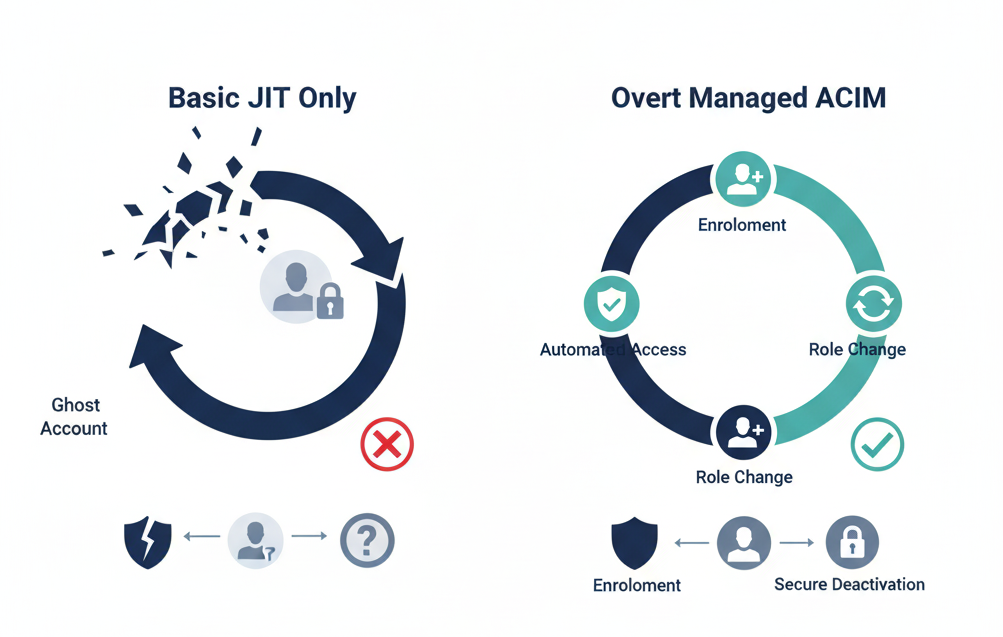
The Danger of JIT-Only Models
A unique insight for IT leaders is the "Shadow Account" trap. Because JIT provisioning only creates accounts upon login, many administrators assume their systems are clean. However, if a user never logs in, the account is never created—but the permissions might still exist in the Identity Provider. Conversely, if a user is deleted from the central HR system, JIT cannot "un-provision" the account from the VLE because JIT only acts during an authentication event.
By integrating Overt’s MIS Integration solutions, institutions can reconcile JIT events with the "source of truth," ensuring that accounts are not only created when needed but also deleted when they are not.
The Rise of Predictive Provisioning
As we move through 2026, we are seeing the emergence of Predictive Provisioning. By using timetable data and enrolment signals, systems can "pre-warm" accounts. This ensures that when a student walks into their first lecture, their VLE profile is already optimised with the correct course materials, preventing the "first-day lag" that often plagues manual or simple JIT systems.
Strategic Integration: Connecting MIS to your VLE
Bridging the Gap Between Student Records and Digital Learning
The most critical link in the automated user lifecycle for the UK education sector is the connection between the Management Information System (MIS) and the Virtual Learning Environment (VLE). Without this integration, even the most sophisticated Just-In-Time provisioning remains a siloed solution.
By implementing a dedicated integration layer, such as the solutions offered by Overt Software, institutions can ensure that enrolment data flows directly into the VLE. This means that as soon as a student is assigned to a module in the MIS, their corresponding course access, group memberships, and learning pathways are automatically prepared in Moodle or Canvas. This synergy between Access Management and Identity Management creates a "birthright access" model, where users receive everything they need to succeed from the moment they first authenticate.
Security First: Reducing the Attack Surface
Automating the user lifecycle is a fundamental pillar of modern cyber security. By removing the reliance on manual administration, organisations significantly reduce the risk of human error, such as granting excessive permissions or failing to deprovision accounts. In the context of the 2026 Compliance Imperative, having a centralised, automated "Source of Truth" allows for instant, accurate audit logs—providing the evidence required for regulatory reporting and ISO certifications.
Key Takeaways: Future-proofing Your Identity Infrastructure
The combination of Automated Cloud Identity Management (ACIM) and Just-In-Time (JIT) Provisioning is no longer a luxury for UK institutions; it is a necessity for maintaining operational continuity and security in 2026. While JIT provides the "front-door" convenience of instant account creation, ACIM ensures that the entire lifecycle—from the first login to the final departure—is handled with precision and compliance.
Overt Software Solutions specialises in bridging these complex technical gaps. Whether you are looking to integrate your MIS with your VLE or require a managed Shibboleth and Azure AD/Entra ID environment through our SAAM Bridge, our team provides the expertise to eliminate manual overhead and secure your digital campus.
Take the Next Step
Is your current identity infrastructure ready for the 2026 security mandates? We invite you to contact us for a Free Identity and VLE Health Check. Our expert engineers will review your current configuration, identify potential security gaps, and provide a tailored roadmap for your automation journey.
Contact Overt Software Solutions today to begin your transition to a fully automated user lifecycle.