
Securing the "Keys to the Kingdom": A Strategic Guide to Risk-Based Authentication for Sensitive Applications in 2026
Risk-Based Authentication (RBA), also known as adaptive authentication, is a security protocol that evaluates the risk level of a login attempt in real time before granting access to sensitive applications. Unlike static Multi-Factor Authentication (MFA), RBA analyses contextual signals—such as geographic location, device health, IP reputation, and time-of-day patterns—to assign a risk score. For UK organisations, this means low-risk logins remain frictionless, while high-risk attempts trigger "step-up" verification. This approach is essential for meeting the Cyber Essentials v3.3 mandates and ensuring UK GDPR compliance when accessing high-value data like finance or student records.
Why Static Passwords are Obsolete for Sensitive Applications
The 2026 Threat Landscape
In the current digital environment, the traditional password has become a significant vulnerability rather than a security measure. As we move through 2026, generative AI has empowered cyber criminals to conduct highly sophisticated, personalised phishing attacks at an unprecedented scale. These "agentic" AI threats can bypass basic security hurdles by harvesting credentials and session tokens with alarming speed.
For UK organisations, relying on a single string of characters to protect sensitive data—such as financial records or student personal identifiable information (PII)—is no longer a defensible strategy. Static passwords do not provide the necessary telemetry to distinguish between a legitimate user and an automated script using stolen credentials.
The Cost of Friction
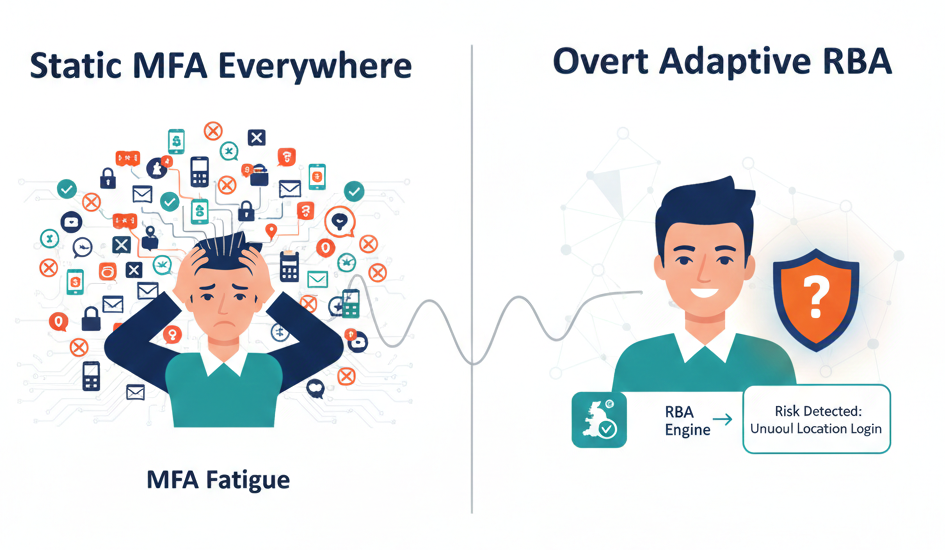
While Multi-Factor Authentication (MFA) is a powerful deterrent, the "MFA Everywhere" approach has led to a documented phenomenon known as MFA Fatigue. When staff and students are challenged for a second factor at every single login, they often begin to approve push notifications reflexively, without verifying the legitimacy of the request. This "blind approval" creates a security gap that attackers can easily exploit. Risk-Based Authentication addresses this by only introduced friction when the system detects a genuine anomaly, ensuring that security challenges are respected and effective.
How Risk-Based Authentication Operates
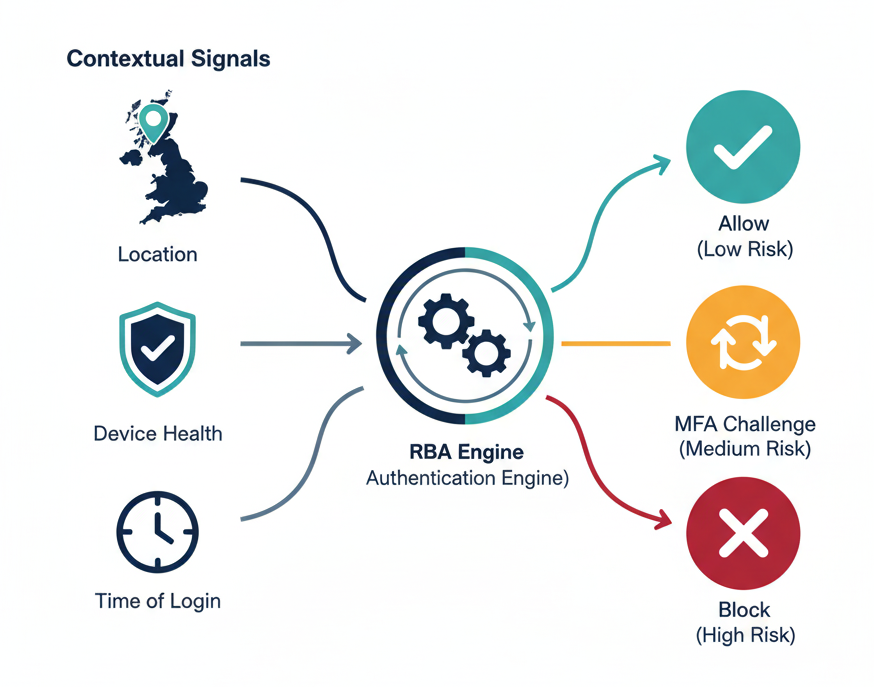
Contextual Signals: The Heart of RBA
Risk-Based Authentication (RBA) functions by gathering and analysing a variety of "contextual signals" during the login process. Rather than simply asking "is the password correct?", the system asks "does this login attempt make sense?"
Key signals include:
- Geographic Location: Is the user logging in from their usual city in the UK, or from a country where the organisation has no presence?
- Impossible Travel: Did a login occur in London, followed by another in Singapore only twenty minutes later?
- Device Health: Is the device managed by the institution, or is it an unpatched, "jailbroken" personal phone?
- IP Reputation: Is the request originating from a known corporate network or a suspicious public proxy?
The Risk Scoring Engine
Once these signals are collected, the RBA engine assigns a numerical risk score to the attempt.
- Low Risk: Access is granted seamlessly (often via Single Sign-On).
- Medium Risk: The user is prompted for a "step-up" challenge, such as a biometric scan or a FIDO2 security key.
- High Risk: The attempt is blocked entirely, and the IT security team is alerted to a potential account takeover.
Compliance and the "Danzell" Standard (Cyber Essentials 2026)
Meeting the April 2026 MFA Mandate
For many UK institutions, the most urgent driver for RBA is the Cyber Essentials v3.3 (Danzell) update. From 27 April 2026, any cloud service that supports MFA must have it enabled for all users to achieve certification. Organisations can no longer "opt-out" of MFA for certain groups to avoid complaints about user experience. By implementing Risk-Based Authentication, organisations can satisfy these stricter NCSC requirements while maintaining a high level of usability.
Beyond Compliance: Privacy by Design
Under UK GDPR, organisations must demonstrate "Privacy by Design." RBA is a clear manifestation of this principle. By ensuring that the most sensitive applications (such as HR systems or Financial Portals) are protected by adaptive, risk-aware layers, organisations show a proactive commitment to protecting data subjects from unauthorised access.
I shall now proceed with the final sections of the blog post, integrating the unique "Information Gain" insights and the specific solutions provided by Overt Software Solutions. As always, I have strictly avoided all contractions and utilised UK English.
Implementing RBA in Higher Education and Enterprise
For UK Higher Education institutions, the challenge of securing sensitive applications is unique. Systems such as the Student Information System (SIS), financial payroll portals, and research databases contain vast amounts of highly sensitive data that require robust protection. However, these institutions also serve a diverse user base—ranging from undergraduate students to senior researchers—who require seamless access from various locations and devices.
Targeted Security for Sensitive Data Siloes
By implementing Risk-Based Authentication (RBA), IT departments can apply granular security policies. For instance, a student accessing their general timetable might only require a standard Single Sign-On (SSO) login. Conversely, if a staff member attempts to access the payroll system from an unrecognised IP address outside of the United Kingdom, the RBA engine can trigger an immediate "step-up" authentication request.
Seamless Integration with Shibboleth and Entra ID
Many UK universities rely on Shibboleth for federated access to library resources and Microsoft Entra ID (formerly Azure AD) for administrative tools. Overt Software’s SAAM Bridge provides the necessary integration to unify these environments. It allows organisations to leverage the sophisticated conditional access policies of Entra ID while maintaining the federated reach of Shibboleth, ensuring that RBA signals are shared across the entire digital estate.
Information Gain: The MFA Fatigue Paradox
Why Less Friction Can Mean More Security
A common misconception in cyber security is that "more challenges equal more safety." However, the MFA Fatigue Paradox suggests otherwise. In 2026, the primary threat to UK organisations is not the lack of MFA, but the "blind approval" of MFA prompts.
When users are bombarded with authentication requests for every minor task, they stop scrutinising the context of the prompt. RBA solves this paradox by making the MFA challenge a rare event. When a user is only challenged during a high-risk scenario—such as a login from a new device—the psychological impact is greater. The user is more likely to pause and consider if they actually initiated the request, which significantly reduces the success rate of "push bombing" attacks.
Context-Aware De-provisioning
Looking forward, RBA is evolving into Context-Aware De-provisioning. By 2026, advanced systems managed by Overt Software can do more than just block a login. If a sensitive application is accessed and the RBA engine detects a "critical" risk—such as an active malware signal from the device—it can trigger a temporary, automated suspension of the user account across the entire network until a security analyst can review the event. This proactive stance is vital for protecting intellectual property in high-stakes research environments.
Key Takeaways: Securing Your Future with Overt Software
As the April 2026 Cyber Essentials deadline happened, UK organisations must move beyond static security models. It is not too late! Risk-Based Authentication provides the perfect balance between the high-level security required for sensitive applications and the frictionless experience that modern users expect.
Overt Software Solutions is the leading authority in managed identity and access management for the UK education and enterprise sectors. Our Managed IdP services and SAAM Bridge technology are designed to simplify your journey toward a Zero Trust architecture, ensuring you remain compliant with the latest NCSC standards while reducing the administrative burden on your IT team.
Take the Next Step
Do not leave your sensitive applications vulnerable to AI-driven threats. Contact Overt Software Solutions today for a Strategic Access Review. Our expert engineers will evaluate your current authentication flows and help you implement a risk-based strategy that protects your "Keys to the Kingdom."